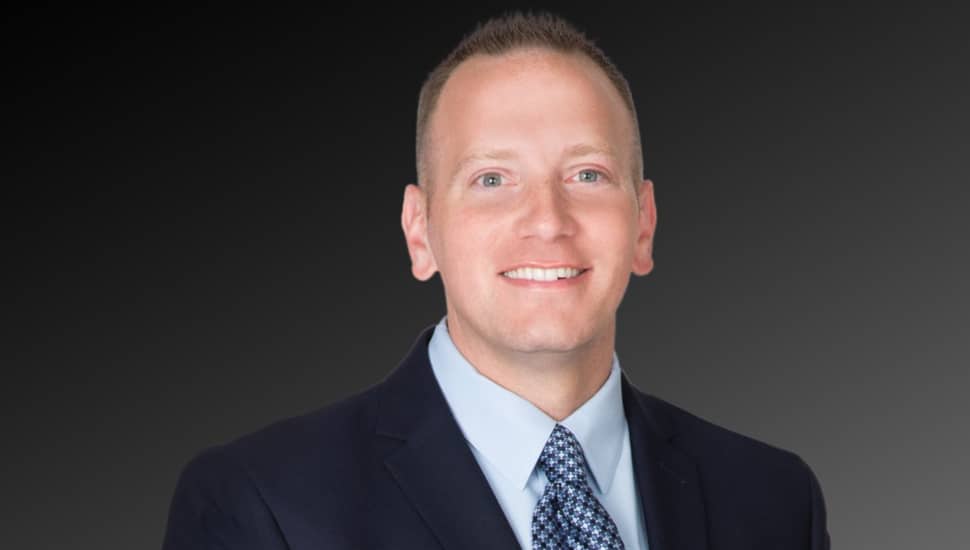

Chris Godshall, Senior Vice President of Commercial Lending at Meridian Bank, spoke with MONTCO Today about growing up in Hatfield Township as the son of a Hairdresser and an Electrician, sharing in his father’s love of cars, and working in a retirement home to afford a vehicle of his own.
While pursuing his finance degree at Penn State, Godshall began working in customer service at Commerce Bank and training to become a Commercial Credit Analyst.
Commercial lending remains his passion to this day, and as SVP at Meridian, he helps turn economic turmoil into new opportunities for startups and growing small businesses.
Where were you born, and where did you grow up?
I was born the oldest of three boys and raised in Hatfield Township in Montgomery County. I still live in Lansdale today.
My parents are still in the same house I grew up in.
If your brothers were in the room, how would they define you as an older brother?
I would think they’d look up to me, but I don’t know. We ganged up on the youngest a bit because he was always coming by and getting involved when we had friends over.
He’s now in business as well. My middle brother is a Teacher at a charter school in Allentown. He loves it.
What did your mom do? What did your dad do?
My mom is a hairdresser. She still does that today. When she was raising us, she worked Thursday, Friday, and Saturday, and was home with us the rest of the week.
My dad was drafted to Vietnam and then became an electrician. He did that until he retired at 67.
What do you remember about growing up in Hatfield?
I remember playing wiffle ball and doing a lot of stuff outdoors in the woods behind us.
I also remember knocking out a few garage windows while playing roller hockey in the driveway.
Did you play any sports growing up, besides driveway hockey?
I played Little League baseball. I tried out for the school team in middle school and didn’t make it, so I hung it up and didn’t take up any other formalized sports.
My mom pushed me to do something, so I took five or six years of piano lessons, but I never took to that either.
The piano was in the living room, so I wasn’t going to be sitting there practicing while everybody was watching TV.
But I stuck with some music. I did chorus in high school.
How did you distinguish yourself in high school?
I kind of coasted through it. It was a big school. I went to North Penn High School; my graduating class was 780.
I had a group of friends, everybody did, but I wasn’t a popular kid, and I wasn’t a nerdy kid or a troublemaker either.
I was under the radar. I just tried to get the best grades I could, because I wanted to go to college.
What drove you to go to college?
My parents said I should try to go to college, and not follow in their footsteps, because that’s what everybody was doing back then.
I respected what they did, but never had an interest in the trades. I was the first one to go to college, and then my two brothers followed me.
What kind of music floated your boat in high school?
I was all over the map. It was the ’90s, so ’90s grunge, Nirvana, stuff like that. Pearl Jam and Alice in Chains were the two I listened to most.
I got into some of the rap that was going on, and some hard rock, like White Zombie.
What about working in high school? What kind of jobs did you have?
My first job was as a server in a retirement community dining room when I was 15. If I wanted to get my license and drive, I had to have some income to pay for the insurance and gas.
I stayed there even after high school, doing different stuff in the kitchen and back office.
What lessons did you learn in those jobs that still influence you today?
It created my work ethic. I didn’t want to half-ass it. I wanted to keep the job because it was my lifeline to be able to drive.
That’s how I am today. I want to do the best I can because I want to continue to advance and provide.
Where does that drive and ambition come from?
Seeing both my parents work and juggle it all. My dad got up at 4 or 5:00 AM in the morning to get ready for work.
I had to get up early anyway to coordinate the bathroom. We had only one bathroom for five people.
He would come home at 5 or 5:30 PM, eat dinner, and get ready for the next day.
Why did you choose Penn State? Where else did you look?
I considered a lot of state schools because I knew they were reasonable. I applied to Kutztown, but I always wanted to go to Penn State.
I didn’t have anybody in the family who went there, but I had grown up as a fan of their football team.
I got accepted, but I was at the satellite campus. It was Penn State Ogontz at the time, which became Penn State Abington.
The plan was to live at home, commute for the first two years, and then transfer up to the university park
My second year there, it became a four-year college and offered the finance degree I was pursuing, so I decided to continue at the satellite campus and work part-time at the retirement home so I wouldn’t come out with as much debt.
I missed out on that main campus experience, but I had friends up there. I would go up there on certain weekends.
Looking back, was Penn State Abington a good choice for you?
I think so. I treated it like another couple of years of high school, just trying to get through it and start a career and make some real money. That was always the driving force.
But it served its purpose. I had a lot of good times there. I remember a lot of the classes, and I made some friends.
Looking back over the last 25 years of your career, Chris, who were the people who saw promise in you and opened up doors for you?
In my second or third year of college, I started working at a local Commerce Bank branch as a Customer Service Representative.
I was talking to the branch manager there about needing an internship, and he pointed me to their Commercial Credit Analyst training program in Devon.
They brought me in part-time while I was in school and promised me a full-time offer when I graduated.
What was it that pulled you into banking?
I had always been interested in the Accounting and Investment side of business, but on the Commercial Lending side, it was seeing how these different businesses work, how they’re financed, how they’re started, and hearing the owners’ stories.
The guy who ultimately brought me to Meridian was Joe Cafarchio. I met him at Commerce Bank while I was an Analyst. He was a lender there and took me on my first client call.
I was a deer in headlights. I shut up and let him do all the talking. But I enjoyed it.
And then, when he went to Meridian, I was looking to get out of Commerce because it was changing a lot. And he asked me to come on board.
I owe a lot of my career to Joe. He taught me the craft of Lending, and Charlie Kochka did as well. I learned a lot from him.
And opportunity-wise, Chris Annas believed in me and moved me along within the bank, even after Joe and Charlie retired.
Here we are, a third of the way through 2026, Chris. What are you focused on? What are you excited about at Meridian?
From the beginning of the year, we started hearing about opportunities because of the turmoil out there. Maybe not mergers and acquisitions, but some banks are shifting focus.
When that happens, it gives us the opportunity for people to start taking our phone calls. We’re always calling, but they may not answer. Now they’re bringing us in and having a conversation.
So, that was promising out of the gates. I think there’s a little bit of a lull between the long, cold winter we had and waiting for the financials to be done.
Some of the rising cost issues are causing some pause. But I think it’s going to pick up in the second half of the year. The things we’re talking about now will come to fruition then. There’s a lot of opportunity.
Some of the existing clients and prospects we’re talking to are pretty optimistic. It was kind of an “eh” year in 2025, but now they want to move forward on some things that they’ve had on the back burner.
There’s some CapEx stuff that’s coming down the pike, too, that I think will spur some action in the second half of the year.
I’m also excited about some of the new technology that we’re investing in to make us more efficient, like our brand-new CRM system.
How do you want Meridian to be perceived among clients and potential clients, Chris?
I want us to be the premier business relationship bank. We prioritize access to decision makers and relationships, so it’s not all about interest rate pricing.
We’ll give you a fair price. We may not be the cheapest, but we won’t be the most expensive, and we will service the heck out of you and be there when you need it. That’s how we’ve always operated.
We’ve worked with a lot of clients through tough times, and now they’re on the other end of it. They don’t forget that we stuck with them when another bank might have pulled the rug out.
I worked with a guy maybe 10 years ago. He was a small HVAC guy whom I was introduced to through a referral from a local CPA. We gave him a small line of credit to start out. In the end, he was buying other businesses and folding them in.
We had a lot of credit out to him at that point, and he ended up rolling it up, selling it, and making his generational wealth.
And he’s still a young guy, so he’s probably going to do it again down the road. We helped him get there, and he’s going to be a customer for life.
What do you do with all that free time that you have?
I dabble in golf, but not well.
From my dad, I got into cars. He was a car guy, specifically Fords. He has a 1971 Ford Mustang Mach 1 that he bought when he got out of Vietnam. It’s blue with silver on the bottom.
He drove it for 10 years. It’s all original. It has probably 60,000 miles on it. He always said, “Eventually, that’s going to be yours.”
But I’m 48 years old, and I’ve only driven it once in my life.
Is it a stick shift?
It is. It’s a four-speed Hurst shifter. When he parked that, he got an F-150, which was a manual. Three on the tree. That’s how I learned to drive stick.
A couple of my first cars were stick shifts, too. I had a Ford Escort GT that was a stick shift, and then a Ford Taurus SHO.
After that, I got a Nissan Maxima that was a stick shift. Back then, I tried my hand at working on the cars when I had more time.
We go to a lot of Ford car shows. There’s a big one in Carlisle that we do every year.
We grew up going to see drag racing at Maple Grove Raceway every year since the event started in 1985. They canceled this year due to the track being sold.
Cars were a nice bond with your father, on all fronts?
Exactly. We have a camper at a campground up in Tioga County. My dad and I are actually going up there this weekend to open it up.
That’s a whole family thing. My two brothers and my parents all went in on the camper.
Three last questions for you, Chris. What’s something big that you’ve changed your mind about over the last 20 years?
I was not involved in any kind of politics. I didn’t want to pay attention to anybody who started a conversation. I didn’t want to address it. I was out the door.
Now, I hear them out, and I’m a little more tolerant of it. I have my opinions, but I try not to express them until I know which way the other person goes.
My mentality was that I didn’t need to vote because it doesn’t make a difference, but now I take it more seriously. And I’m more cognizant that not everyone has the same experiences that I do.
I used to think everyone should be like me, but that’s impossible.
It’s a crazy world out there. What keeps you hopeful and optimistic?
I have a 14-year-old daughter, and she keeps me optimistic that the world is going to be good for her, and I’m going to watch her grow up and do the same thing that I did.
Also, seeing these businesses grow and contribute to the greater good. Everybody has a charitable organization that they support, and that’s a huge part of the community.
Early in my career, I spent a lot of time at chamber events, nonprofit fundraisers, and what we used to call “chicken dinners” — all part of networking, building relationships, and getting my name out there.
Now, I’m like, “Wow, what is this organization? What do they do?” I take it more seriously, seeing the impact they have on the community and people. That’s very encouraging to me.
I never realized how close-knit the business community was with the nonprofits. I’m amazed at how much giving everybody does. If they can’t give money, they give time, which is just as important.
Finally, Chris, what’s the best advice you’ve ever received?
My dad sat me down one day and said, “You’ve got to work hard. You’ve got to take things seriously. When you have a family, you have to be able to provide for them; to do that, you have to work hard.”
Those conversations pushed me to do what I do now.
________________
Publisher’s note: Helen Harris contributed to this profile.