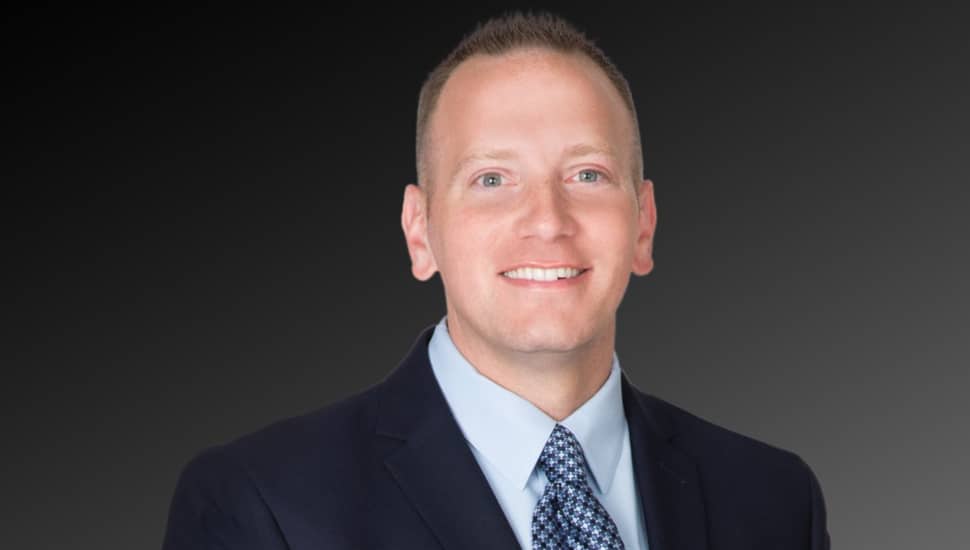
Peter Seibert, President and CEO of Independence Seaport Museum, spoke with MONTCO Today about growing up as the token Protestant in a Catholic school in Harrisburg, working in a museum, and learning about 19th-century history from his grandfather at the dinner table.
Seibert attended Dickinson and Penn State, earning his degrees in American studies, and has served in leadership roles at museums and historical sites around the country. Right now, he’s excitedly preparing the Seaport Museum for the United States’ 250th anniversary with an exploration of our long-standing trade relationship with China and how it shaped our origins.
Where were you born, and where did you grow up?
I was born and grew up in Harrisburg.
What did your mom do? What did your dad do?
My mother was the first woman Broadcast Journalist in the central Pennsylvania market back in the 1950s, when TV was live. My father was a Veterinarian. They divorced when I was a child.
Where were you in the pecking order?
I was raised as an only child, but my father had three children by a prior marriage, and my mother had a prior child.
What memories do you have of growing up in Harrisburg?
I had a great childhood. I was raised by my mother and my maternal grandfather, and in our family, we tend to have children very late, so my grandparents were all born in the 19th century.
My maternal grandparents met in Paris in 1918. They were an Army Captain and a Nurse. If the Archduke hadn’t gotten bumped off, I wouldn’t be here.
People ask me why I became a Historian, and it’s because for us, history wasn’t an abstraction chopped up into centuries as it’s taught in school. It was a dinnertime conversation, and there was a sense of continuity to it.
I grew up with stories of the Great Depression and how my grandfather was recalled to federal duty in the Second World War and worked for General Marshall in D.C.
My mother joked that she voted for Adlai Stevenson, even though her family was all Republican, because she had met him when she covered the convention.
Did you play any sports as a kid?
Not a chance.
How did you distinguish yourself in high school?
I sang in the choir, and I was involved in DeMolay, the young men’s Masonic fraternity. It appealed to everything I enjoyed — public speaking, pageantry, and ritual.
We were Presbyterian, but my mother sent me to Catholic school so I wouldn’t be bused all over creation. So, I was the only Protestant kid in my nine years of Catholic school.
I was elected to a state office in DeMolay, traveled all over the Commonwealth, and memorized all sixty-seven counties. What else does a geeky boy do?
Did you have any jobs in high school?
From when I was 13 to 21, I worked as a tour guide at Fort Hunter, a house museum north of Harrisburg.
The last owner of the house, back in the 1950s, before it got turned into a foundation, said to my mother, “I’ll give you the house if you want to run it as a museum.” And my mother said, “No, I don’t want the place.”
So, 20 years later, she’s on the board, and I’m working there, thinking, “This could have been home!”
What lessons did you learn there that influence you today?
Back when everyone had a job in high school, whether we needed the money or not, we learned the basics of responsibility. When I see kids who have not had that experience, I see what a deficit they have in functioning in the modern working world.
What kind of music floated your boat, Peter?
My musical taste then and now runs the gamut. My daughters are the same way. You could put on the Brandenburg Concertos or ZZ Top, and they’re happy as clams.
But I lean toward singer-songwriters from the ’60s and ’70s.
Did you have a favorite?
Crosby, Stills & Nash. I liked Crosby best because he was the glue, vocally, that held the other two together. Nash high, Stills low. And Crosby would do weird musical tunings that nobody else would do.
My half-sister, by my mother, was friends with David Crosby and had been an opener for him on tour. I didn’t know that until I met her as an adult.
You could have gone to college anywhere. Why Penn State?
I did my first two years at Dickinson College, but I wanted a degree in American Studies, which, at that time, was what people in the museum world did.
Dickinson pretty much announced that their American studies program had lost positions, and they weren’t going to fill them, but they could send us to classes at Penn State.
I thought it was crazy to pay Dickinson $15,000 a year when I could just get the degree from Penn State myself for a lot less.
So, I transferred. The best branch was Penn State Harrisburg, or as we used to refer to it, Penn State Three Mile Island. So, that’s where I finished my bachelor’s degree.
I had a wonderful mentor there as an undergraduate, Dr. Irwin Richman, who went out of his way to teach me to think and gave me opportunities. We’ve remained friends to the present day. I dedicated a book to him two years ago.
He had lots of students, but he saw something special in you. What do you think it was?
On one of his Art History exams, he included a throwaway question, “Who is buried in Grant’s Tomb?” I wrote, “No one, because you can’t be buried in a tomb. You can only be entombed in a tomb.” To which he wrote on my paper, in large red ink, “Wise ass.”
A few weeks later, he invited me to take his graduate-level Art History class, even though I was an undergraduate.
When I graduated in 1987, I started applying for museum jobs, which are always few and far between. I went to a search firm, and they said, “We’ve got a perfect job for you. You can be the Sales Manager at Kinney Shoes.” I said no. I went to another firm, and they told me the same thing. No disrespect to shoe store managers. My wife ran a shoe store. But it busted my bubble as a new graduate ready to take on the world.
The Director of the museum in Carlisle was also a student of my mentor’s, and she called him for a recommendation. Irwin said, “Hire Peter. He’s a rising star.” That’s where my first job came from, cataloging objects on a one-year grant. I was 19 or 20.
Looking back over your career, Peter, who else saw promise in you?
After my year in Carlisle, I got a job as the curator at the Historical Society of Dauphin County in Harrisburg. They hired a new executive director at the same time, and the executive director and the board chairman did not get along.
About three months later, I walked in to find a set of keys on the desk and a note that said, “Congratulations, you’re the Director. I quit.”
So, when you ask who believed in me, it was that first board. I was 21, and they had faith in me to become the Executive Director. I stayed there for five years. I’m still friends with the then Board Chairman.
How did you end up at the Seaport Museum?
There are museum guys and gals who love a particular subject, like trains, and all they do is run train museums. But my skill set is running museums.
I went from running the county historical society to running a bigger museum in Lancaster to running a national organization in College Park, Md., connecting museums with teachers and academics to further the teaching of history.
I went to Taos, N.M. and ran a museum there.
I ran the historic area at Colonial Williamsburg.
I went to Cody, Wyo., and ran the biggest museum in the West.
And then my wife’s mother passed, and we were concerned about her dad and decided it was time to come back east. So, I came to the Seaport Museum.
I joke that my kids aren’t Army brats — they’re history brats. My career has been very lucky. It’s taken me all over the United States.
How long have you been at Seaport?
A little more than five years.
Is there a shelf life for a museum director? Do you see yourself here five years into the future?
I get nervous when people go to an institution and stay forever, because there’s a point where you start saying no more than you say yes. You become caught up in the past and aren’t willing to think differently about it.
I think the nonprofit and especially the museum world demands that you evolve and change constantly. Every place I’ve been has required a different skill set and built on what I learned in the past. I don’t know what the next challenge will be for me.
Here we are, a third of the way through 2026. What are you excited about with regard to the Seaport Museum?
A couple of years ago, I was thinking about what we’re going to do for the country’s 250th anniversary. We talk a lot about battles and the Declaration and the Founding Fathers, but what happened when the United States suddenly needed to start doing business with the world?
We’d been under British policy for a century and had traded mostly with Britain, and now they were our enemy. After the war ends, it’s not a hunky-dory relationship. We went to war with them again in 1812.
We get into an undeclared war with the French. So, our former allies are now not. And we’ve got pirates in Africa.
So, who does the United States turn to to become a global trading power? China.
Really? Way back then?
Uh-huh. Philadelphia was the second-largest city in the British Empire after London. It had a thirst for goods, and it was producing raw materials.
We began trading with China because the Chinese treated everybody the same. We were no better or worse than the French, Dutch, English, or Spanish.
Then, in the 19th century, when we finally opened trade with Japan, we came to see the Pacific as our ocean.
All this begins with Stephen Girard and all those folks sending trading ships loaded with silver to China, to bring back tea, silk, porcelain, goods that Philadelphians loved.
I wrote an op-ed piece about this in the Pittsburgh Post-Gazette, and it said, if China and the U.S. are worried about each other today, we need to step back and realize that we’ve been in this dance since the 18th century.
This is not new. It’s not even a post-World War II phenomenon. It’s not true that only Nixon could go to China. Our relationship with China is a long, cool story, and one I think only this institution can tell.
Is the exhibit open?
It is. It’s the physically biggest and most elaborate exhibit we have ever done. We borrowed wonderful treasures from Mount Vernon and the Society of the Cincinnati.
We have a bowl that a Philadelphia merchant purchased in China for George and Martha Washington. It has a painting of a chain around the border, and each link has the name of a different state on it.
We’re also building a replica of Washington’s Durham boat, and we’re getting ready for the show that will be open this time next year, which will tell the story of African-Americans along the waterfront, particularly the impact of when the I-95 cut the waterfront off from the city.
That’s real recent history, and it’s a great story to tell.
What do you do with all that free time that you have, Peter?
My daughter is a senior in high school, so ask me after she graduates.
I write books. I write a column in an antiques trade paper. I garden. I’m an avid collector of art and antiques. I’m an elder in the Presbyterian Church. I chair their stewardship committee.
There’s a quote from Marcus Aurelius cut into the stone over the entrance to the State Library in Harrisburg. “The role of man is to serve man.” That always resonated with me.
Three last questions for you, Peter. What’s something big you’ve changed your mind about over the last 20 years?
As I’ve grown older, I’ve found the need for a more spiritual aspect to my life. I grew up watching The Waltons, and John Walton espoused this natural philosophy. He didn’t need to go to church, which upset the whole family. He simply had a moral, religious code that drove him.
Ralph Waite, who played him, was a former Presbyterian minister. I found it fascinating that his character has this irreligious aspect, and I always subscribed to that until the last 10 years.
The older I got, the more I realized that sometimes there does need to be that sense of community that comes with it all.
As I’ve become involved in the governance of the church, I’ve realized, with all love and affection to my colleagues, how sometimes very unchristian we can be. But I also know that the vast majority of people are motivated by goodness.
And as a father, watching my daughters grow up has been a different perspective. They’re 26 and 18.
Do you think they’ve benefited from being in a church community?
Absolutely not. And that’s honest. My eldest is exactly where I was. She has a state of irreligious grace.
The youngest is also at a state where I was, where she’s fascinated by it all, more from an anthropological perspective than a theological one.
And that’s fine with me. They’re both enough like me that they will always be asking questions.
It’s a crazy world, Peter. How do you stay optimistic and hopeful?
I believe humanity has survived and will survive. And because we have a propensity to laugh, we will get past the insanity.
You have to acknowledge that we all want to be better today than we were yesterday. We want to be better tomorrow than we are today. At a fundamental universal norm, we believe that about ourselves.
As a Historian, you learn that history doesn’t repeat itself. Human behaviors tend to pattern themselves, but the events aren’t identical.
Shelby Foote, the southern Historian who was on Ken Burns’ The Civil War, has a quote about the Battle of Gettysburg: “Every boy in the South grows up having that dream, that if he had just been there on that day, his presence alone would have tipped the battle.”
In that belief lies the power of both optimism and history. But as someone whose family was on the other side, the blue side, I’m glad that extra boy wasn’t there with the M16.
Finally, Peter, what’s the best advice you’ve ever received?
It was from Irwin. I was frustrated that various personal and professional things weren’t going well, and he said, “You enjoy juggling bowling balls. That’s who you are. Acknowledge that about yourself, and you’ll be fine.”
He nailed it. That was a moment of self-realization.
.
_________________________________________
Publisher’s note: Helen Harris contributed to this profile.