Before Montgomery County had shopping malls, office parks, commuter rail towns and four-lane highways, it had inns.
They stood along old roads and stagecoach routes, offering food, drink, lodging and news to travelers moving through the Philadelphia countryside.
They were gathering places before town halls, landmarks before GPS and, in some cases, the reason a community grew around them. Some historic taverns of Montgomery County are still here.
A County Built Around Its Taverns
The story of Montgomery County’s old inns is not just a story about old buildings. It is a story about how people moved, where they stopped and what happened when they did.
In the 18th century, a tavern was infrastructure. It was where you ate, where you slept, where you heard what was happening in the next town and, sometimes, where history arrived unannounced.
That last part is more literal than it sounds.
At least one of the county’s historic inns temporarily sheltered the Liberty Bell in 1777, when Continental soldiers were moving it out of Philadelphia ahead of the British occupation.
That inn was the Rising Sun Inn in Franconia Township, which dates to 1739 and recently closed after nearly three centuries in operation.
Franconia Township has since moved to purchase the property and preserve it, recognizing what would be lost if the building were sold and demolished.
The Rising Sun Inn’s closure is a reminder that age alone does not protect a place. It takes intention, investment and community will.
The Oldest Continuously Operating Inn in Pennsylvania
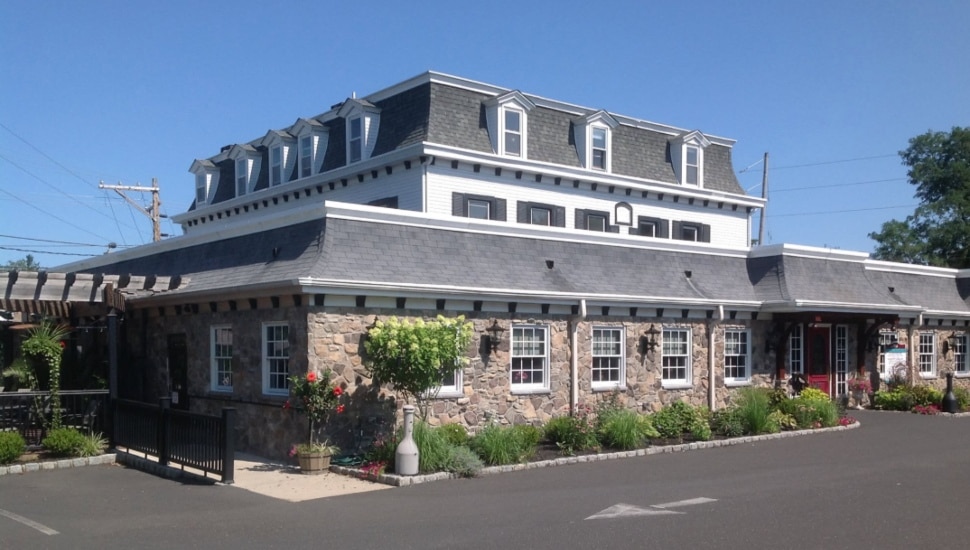
Not every old inn has faced that fate. The William Penn Inn in Gwynedd has been operating since 1714, making it the oldest continuously operating country inn in Pennsylvania.
It has welcomed guests for more than three centuries, surviving wars, economic downturns and the slow transformation of the countryside around it into suburbs.
Today it operates as a destination for weddings, formal dining and family milestones. The history is not decorative.
It is structural, built into the dining rooms, the grounds and the sense of occasion the place carries simply by existing.
The Tavern That Named a Town
The Blue Bell Inn has been open since 1743, but its most remarkable distinction has nothing to do with longevity.
The town of Blue Bell did not give the inn its name. The inn gave the town its name. By 1840, the establishment was held in such high regard that local residents voted to rename their community from Pigeontown to Blue Bell in its honor.
The inn also carries a more famous guest on its resume. After the Battle of Germantown in 1777, George Washington and his troops retreated to the Blue Bell area. Washington frequently stayed at the inn during that difficult stretch of the war.
That history still lives in the building, which now operates as a polished modern restaurant while holding onto the colonial bones that make it unlike almost anywhere else in the county.
History With a Pint
Brittingham’s in Lafayette Hill, established in 1743, is the kind of place that does not need a plaque to feel historic.
The building communicates it. Washington and Lafayette are said to have stopped there after the Battle of Barren Hill, and the establishment later served as a stop on the Underground Railroad, with a tunnel once running from the basement to the General Lafayette Inn next door.
Today, Brittingham’s operates as a pub, which turns out to be exactly the right use for a building like this.
The history stays alive because people keep showing up. It is not a museum. It is a neighborhood bar that has been a neighborhood bar, in one form or another, for nearly 300 years.
When the Bar Is Gone
Spring House Tavern, along Bethlehem Pike, has been welcoming travelers since 1719. It is one of the oldest continuously operating restaurants in the state. Revolutionary War General Lacey referenced it in his military dispatches.
A fire destroyed the building in 1888 and it was rebuilt on the same foundation. Four generations of the same family have owned it. The continuity is remarkable.
Not every old inn has been so fortunate. The Black Horse Inn in Flourtown, built in 1744, has not been regularly open to the public for decades.
It survives as a historic landmark, its exterior restored through years of community fundraising, its interior still waiting.
The building is listed on the National Register of Historic Places and now houses the Springfield Township Historical Society archives.
Even without a bar or a kitchen, it still tells a story.
What These Places Prove
The historic taverns of Montgomery County are not just charming backdrops for a night out. They are evidence.
Evidence that this county was once a place where travelers passed through on foot and horseback, where soldiers sought shelter, where freedom seekers moved through tunnels in the dark, and where a community could love a tavern so much it renamed itself after it.
Some of those places have adapted beautifully. Some have been lost. Others are hanging on. But together, they prove that Montgomery County history is not only found in archives and plaques.
Sometimes it is still standing at the corner of an old road, pouring a pint and waiting for someone to ask what happened there.