CEOs today are navigating a moment defined by competing pressures – remote work, hybrid expectations and a narrow talent market.
Many are sitting on large footprints of underutilized office space – an issue playing out across the country – while simultaneously trying to position themselves near the workforce they need to stay competitive. Today’s leaders are looking for a clear framework – a checklist that gives them long-term confidence in the choices they make about where to locate.
Below are four key questions leaders must ask themselves to determine their long-term location strategy and workforce needs.
1. Is the development pipeline built for durability?
Companies tend to gravitate toward markets where peers and competitors are already concentrated, and a growing, diverse development pipeline is a critical factor in any relocation decision. Leaders are weighing overall area vitality – vibrancy, occupancy and the broader economic trajectory – alongside what the surrounding environment offers their employees.
“In the post-pandemic environment, vacancy rates and leasing velocity are critical to determining a market’s viability to retain and attract new office tenants; however, they do not tell the entire story,” says Patrick Nowlan, Senior Managing Director of Newmark, based in King of Prussia.
“Other factors, like total inventory and investment in other asset classes such as retail and multifamily, paint a much broader picture of investor sentiment and willingness to commit capital.”
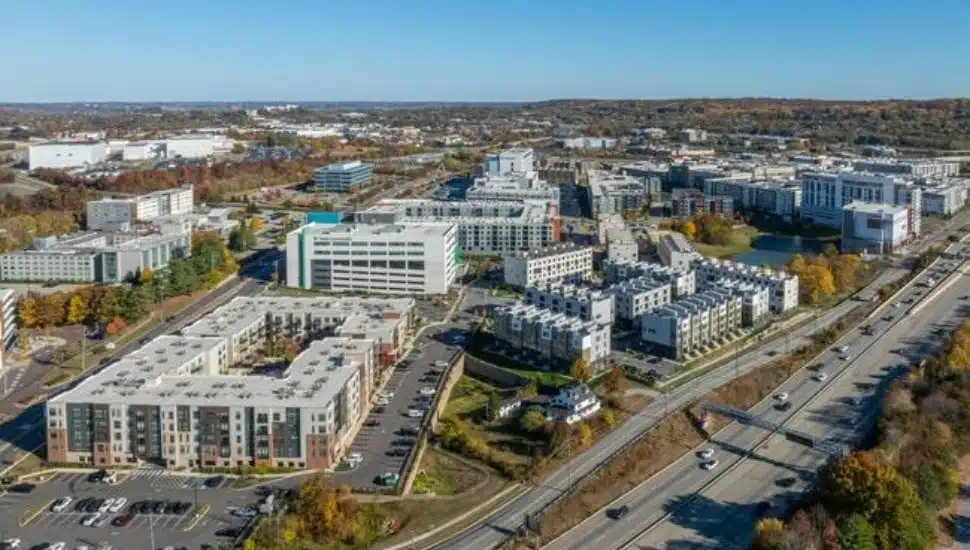
In King of Prussia, the active mixed-use and experiential pipeline is one of the community’s greatest strengths. These factors, including a wide range of retailers, entertainment venues and restaurants, now play a far larger role in corporate location strategy than they did a few years ago.
2. Is public investment reinforcing private growth?
When local governments invest in transportation networks, public spaces and a diverse development pipeline, it signals a region’s long-term stability.
Strong occupancy trends, visible reinvestment, and active mixed-use districts give employers confidence that the surrounding ecosystem will support talent attraction, employee experience and long-term value creation.
To strengthen their commitment to growth, Upper Merion Township created King of Prussia District, a business improvement district, making it one of few suburban communities in the country with the designation.
As part of promoting investor confidence, the District, township and county are committed to strengthening infrastructure. Developing trail networks and improving bike lanes and road access are all extremely important in attracting a diverse mix of companies to a region.
“When evaluating a market, business leaders should look closely at a region’s investment priorities,” says Stephen Forster, Director of Commerce for Montgomery County, PA. “Robust development pipelines and transformative recreational amenities signal a community’s commitment to attracting and retaining the next generation of talent. It’s that long‑range vision and the civic energy behind it that ultimately sustains competitiveness.”
3. Is the community prepared to grow with employers?
For employer retention, environment is everything – and a crucial component is access to quality housing. In the last ten years, Upper Merion Township has grown its housing market by 26%, adding 4,000 rental and for-sale units.
Fortune Magazine ranked the township number two among the 50 Best Places to Live for Families – a testament to the strong demand to live and work here.
“A region’s quality of life directly drives recruitment, retention, and culture,” says Marcia Zaruba-O’Connor, President and CEO of The O’Connor Group, headquartered in King of Prussia. “It’s no longer a nice-to-have – it’s a competitive advantage.
When employees enjoy where they work and live, discretionary effort increases and turnover decreases. That’s the ROI of quality of life – and it’s why smart companies are making it central to every expansion decision.”
4. Are workforce trends aligned with where work is going?
The King of Prussia market mirrors a broader national trend: companies are prioritizing highly accessible locations with strong transportation networks, abundant amenities and high-quality housing and schools.
These factors are now central to how employers think about talent attraction and long-term stability. Companies aren’t just choosing office space anymore; they’re choosing communities that can grow with them.
The relationship between a region’s development pipeline, sustained public investment, community readiness and evolving workforce influences whether a market can truly support corporate growth.
Leaders who approach relocation with this broader, more strategic checklist are better positioned to make decisions that strengthen their organizations, attract talent and create durable value for the decade ahead.
________

Eric Goldstein is the President & CEO of King of Prussia District. Since 2011, he has championed strategic partnerships and initiatives that position King of Prussia as a vibrant, progressive community at the forefront of the suburban transformation movement.
.
.
.
_________
This article originally appeared on Philadelphia Business Journal’s website.