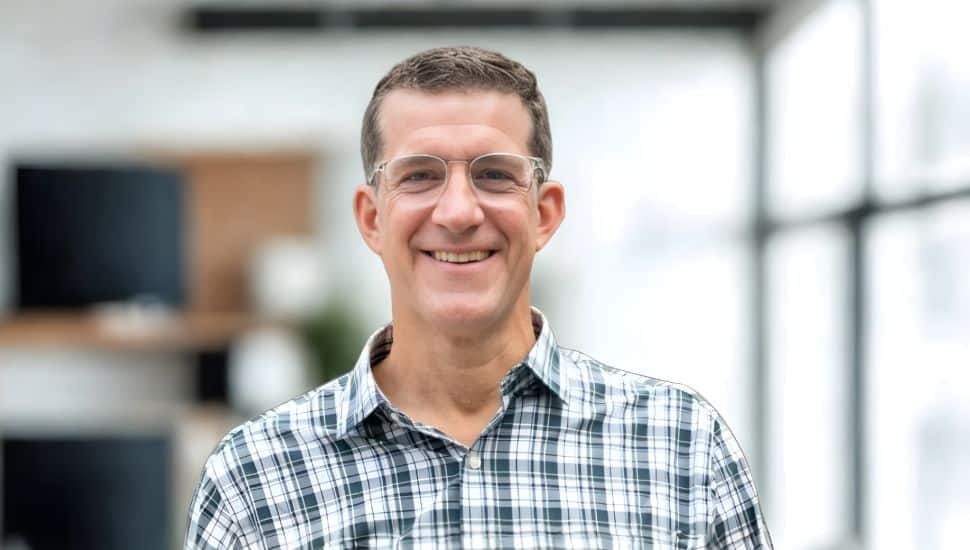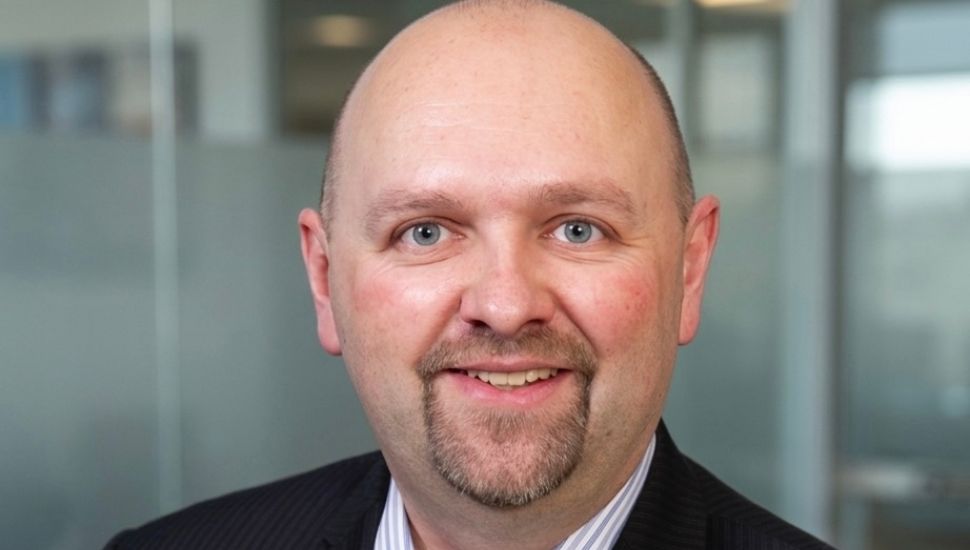

Alex Balagour, EVP and Chief Information Officer at C&N, spoke with MONTCO Today about his globe-hopping childhood as the son of an economist and an electrical engineer from what was then Soviet Ukraine.
Balagour immigrated to the U.S. with his parents when he was 16 and spent his youth exploring the offerings of his local community college while bussing tables and making his first forays into the banking world.
After completing his degree in computer science, he returned to banking and now serves C&N and its customers by investing in technologies that improve customer experience and the bank’s efficiency.
Where were you born, and where did you grow up?
I was born in Ukraine, in the same town that Volodymyr Zelenskyy, the President of Ukraine, is from. I still have some family over there. Growing up, we lived in a different republic of what was then the Soviet Union, called Moldova. After that, we lived in Nigeria for about three years until we moved to the United States in the early nineties.
How old were you when you got here?
Two weeks short of turning 16. I’ve been in the Bucks County area ever since. My parents still live in Warminster, and my family and I live in Langhorne.
What did your mom and dad do?
My mom is an Economist by trade, and my dad is an Electrical Engineer. It was my dad’s career that took us all over the place.
Where are you in the pecking order?
I’m an only child.
You had an eventful childhood, moving around to some pretty diverse places. What memories stand out for you?
The things I remember most revolve around my grandparents. Silly things like the evening TV news blasting through the whole apartment because my grandfather was hard of hearing. During the fall season, my other grandparents were always canning and pickling vegetables, which was a massive production. This is something that is not generally done anymore.
How did you adjust to those different places? What skills did you develop?
As a child, adjusting isn’t that difficult. From my current perspective, going to Africa sounds extreme. But at that time, I had friends, and there was a pool. What else does a 13-year-old need?
The biggest adjustment was coming to the States, because I realized it was not just another pit stop on the journey. This was now home and my future. It was the realization that the time had come to grow up and figure out college, career, and everything else.
What surprised you the most when you first came to the United States?
The abundance of stuff—the variety of cars, produce in the market, malls, the shopping experience — stuff everywhere. That’s not the experience in many other parts of the world.
Did you play any sports when you were growing up?
I tend to think about my “growing up” years more in Africa, and my school there wasn’t big enough for team sports. I spent a lot of time playing tennis, table tennis, and hanging out by the pool.
Were you good at tennis or table tennis?
I would say I was pretty good. Again, the school was not that big, but I took second place in table tennis.
Did you play chess at all?
In the earlier grades, for sure, but it faded away over the years. Growing up in the Soviet Union, chess was a pastime.
What about jobs when you were growing up?
I didn’t work until I was in the United States. My very first job was clearing out overgrown weeds and shrubs before a contractor could start a project. That lasted two or three back-breaking days. Not my proudest moment quitting it, but I’m glad I experienced that.
Then I bused tables for a number of years. Back in 1995, I had an early job working on branch conversions when PNC acquired Midlantic. Technically, with some breaks along the way, I’ve been in the banking industry for over 30 years.
You seem to have always had a good work ethic.
I didn’t really have a choice. That’s the American dream and the opportunity that comes with it — but no one hands you the dream; you have to work for it.
What lessons did you take from your time in restaurants that guide your life today?
You have to be on time. You have to be pleasant. There’s a degree of customer experience that you need to uphold, regardless of how you are feeling that day. If you don’t do that, you’re not going to work there the next day. And details matter. If you clean a table and you miss a spot, that comes back to you.
What kind of music floated your boat when you were a kid?
The only class in college that I did not ace was “Appreciation of Music.” My music taste is whatever’s on the radio. And frankly, for the past several years, it’s been more podcasts than music.
So, you get ready to go to college, and your parents aren’t much help, I’m going to assume?
Perhaps not financially, but my parents’ expectations were very clear: moving to the States meant you might get a job to make a little money, but you had to take at least one college class at a time. You didn’t have to have a degree identified. You didn’t have to go full blast. But you did have to stick with it and work toward a degree.
The easiest way to satisfy that requirement was to enroll in community college, so I went to Bucks County Community College for more than four years. I took introductory courses in just about everything, and it took me some time to figure out what I wanted to do with my life. A bit tongue-in-cheek, but my career is the result of choosing the easy way out. Intro to Computer Science was the easiest class for me, and I stuck with it and managed to turn it into a productive career.
Where did you go after BCCC?
I ended up going to Arcadia University. It used to be Beaver College. After my self-discovery time at Bucks, I knew what I wanted at that point, and I wanted to finish my bachelor’s degree in Computer Science as quickly as I could. I followed that about a decade later with an Executive Master’s in Technology Management from the University of Pennsylvania.
Why Arcadia?
At that time, I was not a United States citizen. While Penn State would have been the most cost-effective option for most, I was considered an international student, which would have quadrupled my tuition. Arcadia University was more cost-effective, and because it was local, there were no boarding costs. Arcadia also accepted 99 percent of my credits from Bucks. Plus, proximity allowed me to work full-time and go to school at night. There was one term when I was at school every Monday, Tuesday, Wednesday, and Thursday night; Saturday afternoons; and every other Friday. I aced all the classes except … Music Appreciation! And I had no social life that term.
Who saw promise in you, Alex? Who saw what you bring to the table and gave you opportunities and opened up doors for you?
As I was looking for internships and co-ops at BCCC, there was one professor, Gordon Fish, who recommended that I consider a SmithKline Beecham co-op, where I worked for another Bucks County alum, Sal Villari. Unfortunately, Gordon is no longer with us, but I’m still in touch with Sal. He’s been a mentor for years, maybe more of a friend now. I went through the same grad school program that Sal did about 15 years later.
At one point, I worked for FMC Corporation in Philly, and the CIO there, Dave Kotch, was also someone I looked up to as an aspiration for my personal career.
What did Dave see in you?
I suppose it’s the ability and willingness to get stuff done. If he asked, “Hey, do you think you can do this?” my answer was always, “Yes.” I would say “yes” before I even knew what the project was! That still catches people by surprise, but over time, I think it creates a level of trust and appreciation for my commitment.
Years later, as I progressed through my career, one of my classmates from grad school, Jack Allison, brought me back into banking. I never left again, and that was 12 or 13 years ago.
How did you get to C&N?
I was recruited by an executive recruiting firm. I wasn’t looking to make a switch, but when I learned more about the C&N story, their growth plans, and the vision our CEO, Brad Scovill, had for the company, it was hard to turn it down.
I liked the idea of community banking. There’s something “holy” about safekeeping deposits for someone and lending them out to their neighbor. Maybe not literally, but the bank does support and invest in the community in many different ways. That’s important to me.
I liked the potential to build out the company infrastructure for growth and sustainability. The technology space evolves so fast. My job today is very different from my job five years ago. That’s probably true for every technologist. But it was an interesting opportunity to run technology for bank operations, for the call center, and do things that are outside of a typical CIO role. I learned to truly be an executive of the company as opposed to just being an IT operator.
You were a doer, and now you have to be a leader of doers.
That’s exactly right. I can’t do it all by myself, and that’s been the mantra of my career. Developing that skill was very deliberate. The speaking classes definitely paid off. I’ve made the effort to put myself in situations to battle-test my ability to lead people, to develop a vision, come up with a strategy, and communicate it. And all that has to work in the context of the environment I’m in. So that means being aware of my peers’ corporate objectives and getting them all aligned.
What challenges and opportunities are on your plate right now? What are you most excited about as you look into the new year?
The banking industry is surprisingly dynamic. It may not be immediately obvious from the outside, but there are a lot of moving pieces and a lot of change. Sorting that out has been a journey for C&N and other banks.
When we think about our future, investing in technology where it makes sense is key, and doubling down on what we do well, which is building relationships with our customers. We don’t want to become one of these big, monolithic, soulless, heartless banks. We want to be the community’s bank. We want to be “your bank.” We know our customers by name. When you call us, there is no call tree; you get a person. That’s unusual these days, but that’s the commitment we make to how we run the business.
So, from my perspective, the focus is on finding opportunities for technology to bring efficiency and reduce costs from the operations, so we can continue to invest in those channels where our people engage with the customers.
We completed an acquisition last year, so we’re continuing integration efforts, and one of my objectives is to be ready for another acquisition. I don’t know if it’s coming this year or next, but that’s our articulated strategy.
How are you managing the AI wave that’s coming at you?
I did have a big moment of fear about a year and a half ago. I thought, “Oh my gosh, are we as a company going to miss the boat, and the AI wave is going to sweep us away?”
But I have a more pragmatic perspective these days. AI is not going to fundamentally change who we are or what we do in the marketplace. So, we treat AI initiatives like any other initiative within the company.
We worked out certain compliance constraints that we’re not willing to cross with AI. But at the same time, we’ve done a lot of work to improve efficiency through AI tools. We are looking for opportunities to completely reinvent certain processes at the bank.
One example would be related to running the call center completely differently with integrated AI. That doesn’t mean a robot answers the phone, but it could mean supporting our agents so that all they do is talk to our customers instead of spending time on screens, clicks, logs, and documentation. We’ve seen some great results, but — I’m going to butcher a quote from my favorite economist, Mark Zandi from Moody’s — technology waves run through the industries a lot slower than people think.
What do you do with all your free time?
We haven’t talked about my family much. My spouse works; we have two kids in grade school with all the related activities, and we have four pets. I’m not quite sure what this “free time” you speak of is… but I do enjoy light woodworking and general home improvement projects.
What’s something big that you’ve changed your mind about over the last 15 or 20 years?
Maybe it’s simplistic, but growing up on the Computer Science path, I started out as a Technologist. But now, when I introduce myself, I frequently say something like, “Hey, I’m Alex Balagour — a recovering Technologist.”
Technology in itself is not the endgame. What technology brings to us — or enables us to do — is what really matters. And that’s very different from my original thinking about the industry and my career.
How would you describe yourself today? Not a Technologist, but a …?
Business Executive. After 30 or so years, I still think of myself as an amateur Banker, so maybe I’ll stop one step short of calling myself a Banking Executive. But my job is to find good investments in technology for the benefit of C&N and ultimately, for the benefit of our customers.
What keeps you hopeful and optimistic, Alex? It’s a crazy world out there.
I think about history and my world and what technology has empowered just in my lifetime. Technology is now defined in a broader context than just computers. I have running hot water. Seats in my car are hot and cold when I feel like they need to be. I can have almost anything delivered to my house in under two days.
We completely underappreciate how easy some of our lives are because of technology. And that trajectory is not slowing down. AI tools can create an opportunity to make things better for all of us. It may take 10 or 15 years for us to truly adopt all of these components, but if we can manage to not self-destruct, we’re on the path to a pretty wonderful future.
Finally, Alex, what’s the best advice anyone ever gave you?
I have been carrying this quote with me for a while and, unfortunately, I don’t remember where I heard it. It may have been one of the early coaching sessions that we were running at our company. But the line is, “Build the machine. Don’t become the machine.”
My interpretation of that and the way I apply it: if I am the only one who knows how to do something, that means I become the bottleneck in the process. I am very needed, but I’m holding my team back. But if I can enable others, I bring a lot more value to the company: they move faster, and they’re not dependent on me.
________________________
Publisher’s note: Helen Harris contributed to this profile.