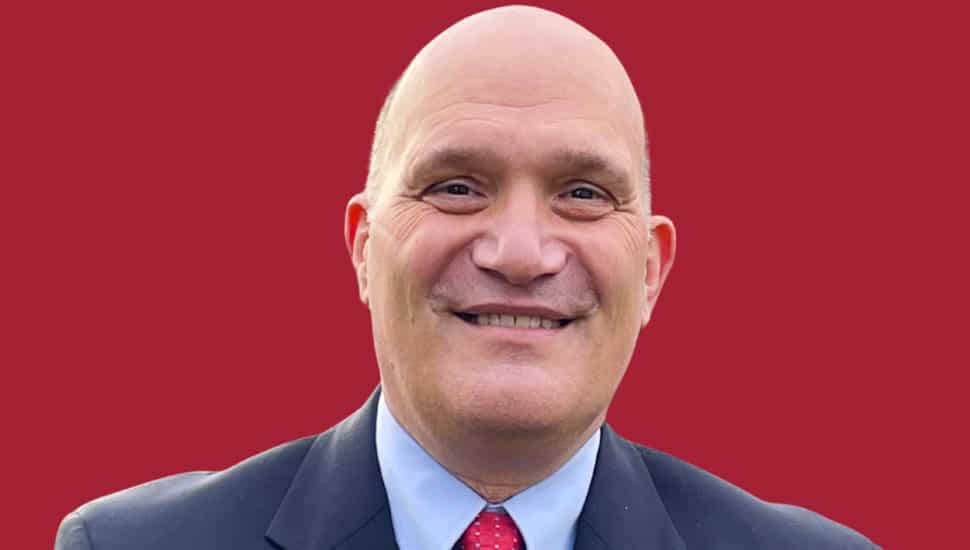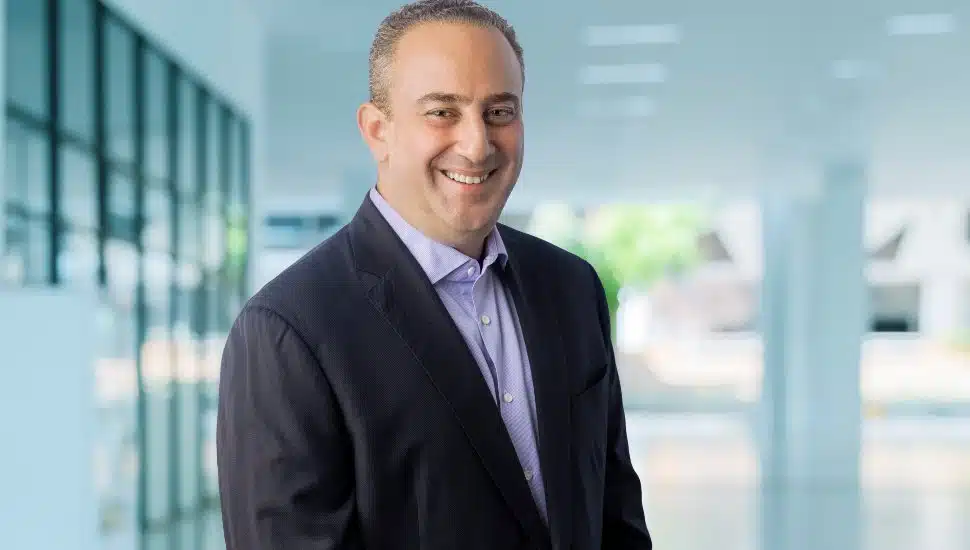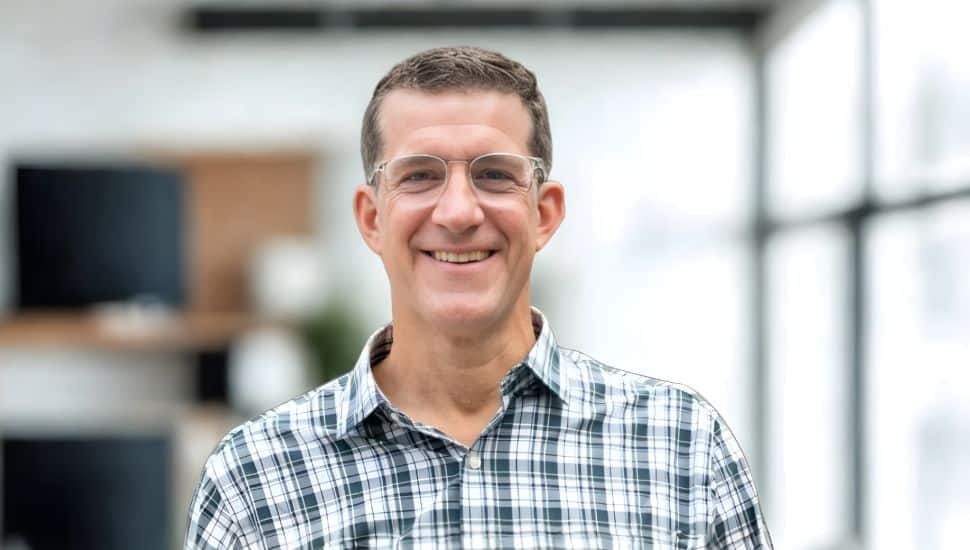

Tom Peterson, CEO of Blackbird Health, spoke with MONTCO Today about growing up in New England, balancing athletics and academics as a competitive swimmer at Harvard, and the personal experiences that ultimately led him to pediatric mental health leadership.
After building and exiting successful businesses, Peterson returned to school mid-career to earn a counseling degree from George Washington University. When several of his own children struggled with mental health challenges during COVID, the experience exposed gaps in the care system — and ultimately led him to Blackbird Health, where he is focused on bringing a more holistic, understanding-first model of pediatric mental healthcare to families.
Where did you grow up?
I grew up outside Boston and stayed there through college at Harvard. After graduating in ’92, I moved to the D.C. area and have been here ever since, with a couple of short stints elsewhere.
My family lives in Vienna, just outside the Beltway on the Orange Line. D.C. can be a transient place, but Vienna has been a great town to raise kids. We’ve been in the same house for 24 years.
What role did swimming play in your early years?
Swimming was a big part of my life. I competed at Harvard and later trained for the ’96 Olympic trials. Individual medley, backstroke, and freestyle were my main strokes, mostly middle distance.
Tell me about what brought you to Blackbird.
I’ve always been passionate about mental health. Mid-career, between two businesses I was helping lead, I went back and got a mental health degree in counseling at George Washington University.
During COVID, three of my kids had pretty significant mental health challenges. I had exited my past business, which we had taken public, after putting 10 years of blood, sweat, and tears into it, so I was at home with the kids. The fact that I couldn’t find the clinical models to support them is what led me to Blackbird Health.
There’s a lot of trial and error in pediatric and adolescent mental health.
My daughter, who had severe depression, was on three different failed SSRIs and had bad side effects from them. We would get 15 minutes with a psychiatrist, and they’d try something else. We got her a genetic test through Blackbird, and those same three drugs were flagged as high-risk for those side effects. If we had done the test earlier, it would have saved three years of her life. We could have gotten her on a drug that helped.
And then my son is very high-functioning autistic, but he had been kicked out of three different preschools because of his volatility. It was largely ADHD, but with a strong sensory component. He would be answering a teacher’s questions, but it would be the teacher two classrooms down. He couldn’t filter sensory input, which led to a lot of dysregulation and hyperactivity, and he was on the path of being labeled as an oppositionally defiant kid.
We had a very extensive neuro-psych eval done on him, and it was a 30-page report with no prioritization, no actionable recommendations, or follow-up.
How did you find out Blackbird existed?
The two co-founders of Blackbird had a single clinic in Allentown. A common acquaintance introduced me to them because I was researching pediatric mental health businesses with different clinical models that addressed the time-to-stabilization issue.
I started as an advisor and investor, but with COVID, they went from clinic-based to virtual, and I got three of my five kids into care with them. They needed a CEO, and I decided that was how I wanted to spend the next chapter of my life, investing in getting their clinical model out to as many kids as possible.
What was it about Blackbird’s model that drew you in?
In mental health, the predominant method for diagnosing is what’s called the DSM-5. It’s a diagnostic statistical manual, and it’s an aggregation of symptoms. Basically, if you have five of the eight symptoms, you get diagnosed with ADHD, autism, or anxiety.
The problem is that it gives you a diagnosis, but it doesn’t tell you what’s driving that diagnosis. I have three kids with ADHD, and they have three different drivers of their ADHD.
My oldest has an anxiety driver. A lot of her difficulty focusing comes from nervousness. My older son has a speech and language component. He comes off as inattentive, but he’s really just trying to understand what you’re saying and form his thoughts back to you in a coherent way. And then the son I mentioned, who has some autism features, has a sensory/motor component to his ADHD.
Where the standard of care is now, they all would have gotten a stimulant and maybe some executive function coaching. But what we’ve identified by looking at eight different domains of the brain and the child is that there can be lots of different drivers of these diagnoses, and knowing what that driver is leads to different treatment plans for those kids.
Blackbird uses what we call an understanding-first approach. What we do is scan to determine whether something may exist in an initial upfront assessment, and if it does, we’ll do a follow-up assessment. So, if we see something in social/pragmatic language skills, we’ll do a deeper speech and language eval. If we see something in sensory/motor, we’ll do an occupational therapy eval. If we see something in autism or developmental, we’ll do an autism eval. If there are cognitive issues, like processing speed or short-term memory, there are things we can do to determine if there are cognitive drivers to the diagnosis.
Then we have an integrated treatment team that delivers the treatment plan. So, instead of trying to find a psychiatrist, a developmental specialist, and a speech-language pathologist, those are all in-house resources.
And what are the results you’re seeing that are different from a standard approach?
Continuing with the ADHD treatment example, 70 percent of kids with an ADHD diagnosis get a stimulant. That’s the industry standard. We believe in stimulants, but there are reasons why you wouldn’t want to use them.
We prescribe them in about 35 percent of ADHD cases, but regardless of whether the child’s on a stimulant or not, 90 percent of our kids are meeting their treatment objectives.
How do you scale this very personal, one-on-one approach?
First, we’ve built technology that supports the clinicians in conducting the initial assessment. We call it our Cockpit, and it collects 6,000 data points as you’re recording the child’s responses, more than a single human could pick up.
Then, based on what it flagged in the assessment, it recommends the next steps. This will continue to be enhanced through AI, but it’s all clinician-reviewed and clinician-led.
Second, we’ve built residency programs for recently graduated psychiatric practitioners to train them on our model. The industry was not producing psychiatric practitioners who treat this way.
You come out as a psychiatrist or a psych NP, and you’re exclusively assessing whether to medicate or not and which medication to use. Our psych NPs and psychiatrists are much more holistic. Since we’re always growing, we’re always hiring.
Third is by tracking outcomes. Measurement-based care allows you to track and see whether a person is progressing as expected and what adjustments need to be made.
Mental health symptoms complicate parenthood. How does your approach help the families?
For me, one of the most helpful things about Blackbird was understanding why my son’s behavior was happening. It was a whole education for me as a parent.
And there’s a lot of interplay between the parent and child. My anxiety might be playing into my child’s anxiety. You can’t just address the child.
We heavily involve parents in guiding and carrying out their child’s treatment, and we also have parent therapy. We have DBT and a program called SPACE that we offer parents for anxiety.
We have parent coaching programs to help them learn what they could do differently to support the child. That’s actually a big area of expansion for us.
How are you going to roll this out across the country?
As well as recruiting, training, and automating, we intentionally chose to be virtual first, which is important for reaching a wider area. We strongly believe in our clinics, but about 75 percent of our kids don’t need an in-person setting.
The other key to going national is through payer partnerships. We work closely with insurance companies. We have developed strong referral relationships with them.
The payers and pediatricians we work with bring us into new markets. For example, Independence Blue Cross has AmeriHealth in New Jersey, and there’s a large pediatric practice we’ve been working with in Pennsylvania that has a number of clinics in New Jersey. So, they’re now helping us launch in New Jersey.
Another large pediatric group we’ve been working with in Virginia is bringing us over to Maryland. And CareFirst, which is a big payer, covers both Virginia and Maryland. We use those relationships to determine where we should go next.
Keeping quality consistent, whether it’s virtual or in-person, must be a challenge.
Not really. We can do most of what we do virtually. People will ask how virtual care for a six-year-old could be as good, but a lot of what we do is work with the parent.
And the other part of what we do is observe the child in their environment, which doesn’t happen in the clinic. Like, my child is doing therapy one-on-one with a play therapist, but where I really need that therapist is in the house, when there’s an issue between him and his brother.
But some kids do need that in-clinic support. So, the challenge is less in ensuring consistent quality across virtual and in-person and more in ensuring we have the right clinicians to match with patients’ needs.
What kind of impact are you seeing on the children? How is their life different after an experience with Blackbird?
The primary thing we hear from kids is that the noise goes down. There’s so much internal dialogue and noise, regardless of the diagnosis. Whether it’s through therapy, medication, or just support, we’re creating a stable platform for the child to focus on the things they need to focus on in order to develop along a typical developmental pathway.
What impact are you seeing on the parents?
What parents tell us is, “For the first time, somebody understands my child. I knew something was going on, but nobody else had seen it. And within two sessions, you got it.” The average time between when a child indicates a symptom and gets diagnosed is about 13 years. They don’t get access to care at that time.
There are tools we use to measure how both the child and parent are feeling about their quality of life, but it’s much more qualitative than that. There’s hope and relief in finally having a roadmap.
Where do you see Blackbird in five years? Do you see yourself as a national service in that time?
It’s a good question as to whether we’ll be national or just continue to grow across states. The challenge with virtual clinical offerings is that the clinicians have to be licensed in the state where they’re practicing. Some states require local, in-person exams. So, for our core clinical model of delivering mental and behavioral health services for kids, I think we’ll continue to expand regionally.
Some of our educational services or parent support could lend themselves better to scalable SaaS-based products. We’re building on this clinical evidence base in a clinical lab of delivering mental health support, but as we expand into other markets, we could expand into different offerings that all build off this concept of precision.
How can a parent access Blackbird Health?
A lot of other companies have failed because they’ve spent a lot of money on direct-to-consumer ads to get access to parents, but there’s no trusted relationship. We think it’s important to be community-based, so 70 percent of the families who access our services learn about us through local word-of-mouth or a recommendation from their pediatrician, their school counselor, or another mental health provider.
The other 30 percent might see us through social media or “near me” Google searches. That’s another big part of increasing our market penetration. With enough strong Google reviews and traffic to our presence, even a purely virtual company can pop up in “near me” searches without a sponsored ad.
Is there anything else you’d like people to know about Blackbird?
Our mission is not just to expand our services, but to change the standard of care. We would love for others to adopt the same methodology, instead of moving too quickly to services without really understanding the problem.
A lot of people really want a specific service for their kid, like EMDR or PCIT, and it’s because that service worked well for a friend, or because ChatGPT told them it’s what they should get. People often buy products, but we sell solutions.
We want people to understand that solutions only work if they’re matched with the right problem. That seems intuitive to us, but it’s not how the industry has been organized. We want to continue publishing research on our outcomes to change the standard of care across the industry.
Learn more at Blackbird Health, the top-rated mental health provider for young people in the Mid-Atlantic. Blackbird Health offers comprehensive virtual and in-person care at its Pennsylvania clinics in Allentown, Exton, Langhorne, Fort Washington, King of Prussia, Doylestown, and Media, as well as locations in Mount Laurel, N.J., and Northern Virginia (Tysons and Centreville). Most services are covered as in-network with most major insurance carriers.
__________________
Publisher’s note: Helen Harris contributed to this profile.