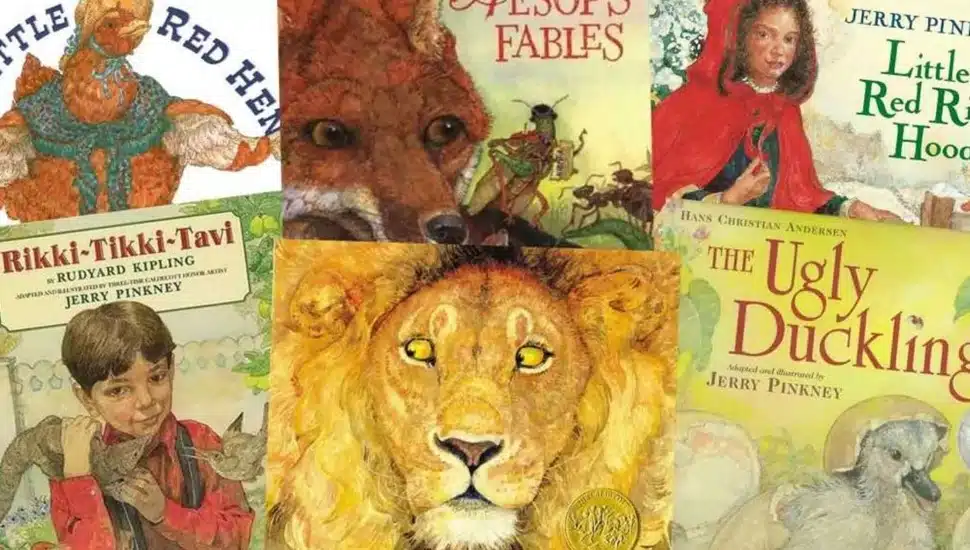

In the watercolor world of Philadelphia-born artist Jerry Pinkney, even small moments can capture your imagination. Lions and mice share quiet, wordless courage; mermaids find their voices; and foxes and rabbits outwit trouble with heart. A National Medal of Arts recipient and one of the most beloved illustrators in American history, Pinkney’s art, rooted in Black storytelling traditions and overflowing with humanity, invited generations of children to see themselves reflected in tales of resilience and kindness.
That legacy is being carried forward by today’s educators. Among them are Abington Friends School teachers Keisha Hirlinger and Amy Diaz-Newman, who both contributed to a new national curriculum, “Soul, Sound and Voice: The Art of Jerry Pinkney,” as part of an exhibition currently on view at the Woodmere Art Museum in Chestnut Hill. The exhibition celebrates Pinkney’s life and work while exploring how visual storytelling can nurture empathy and justice.
Teaching the Power of Voice
For Hirlinger, the invitation to write a lesson plan came after years of creating arts-based curriculum for major organizations, including the Philadelphia Orchestra and the Savannah Music Festival. This project, she says, felt like a special opportunity “to connect art, music, and justice in one breath.” Her lesson, inspired by Pinkney’s reimagining of The Little Mermaid, centers on the theme “Finding Your Voice.” In Pinkney’s version, the story is not about princes or romance, but friendship and courage: the decision to speak up for oneself and others.
“It’s about being an upstander,” Hirlinger said. “The mermaid learns to use her voice to stand up for her community, for her friends, for herself.”
Hirlinger’s curriculum invites students to write their own songs of advocacy. Using familiar melodies, children compose new lyrics that express kindness, courage, and social justice. The guide includes templates for songwriting, vocabulary supports, and ideas for making simple instruments from everyday materials.
“It’s written for classroom teachers, not just music teachers,” Hirlinger said. “Anyone can bring it to life, and that means more children can experience music as a tool for empathy and expression.”
Reclaiming Stories Through Craft
For Diaz-Newman, the project offered a chance to connect her long-standing partnership with the Woodmere to a powerful cultural legacy. A longtime art educator and member of local art-teacher networks, Diaz-Newman has collaborated with the museum for years through exhibitions and student showcases.
When invited to contribute a visual arts lesson, she chose to focus on Pinkney’s illustrations for The Complete Tales of Uncle Remus, stories rooted in African-American folk traditions that have too often been misrepresented in mainstream culture.
“I wanted to lift those stories up again,” Diaz-Newman said. “They shouldn’t be discarded just because someone once handled them poorly. These tales come from an oral tradition that deserves to be told with care.”
Her lesson invites middle school students to design colorful puppets inspired by Pinkney’s animal characters, combining storytelling, craft, and performance. Students explore how art objects can become vehicles for empathy, humor, and voice. “Kids love anthropomorphic characters,” Diaz-Newman said. “Through these puppets, they can play, create, and share the stories again, keeping that oral tradition alive.”
Diaz-Newman’s teaching philosophy reflects the same balance of craftsmanship and storytelling that animates Pinkney’s work. A trained printmaker and portrait artist with a deep background in art history, she believes that every art experience should integrate three elements:
- Technique: building skill and confidence with materials
- Appreciation: understanding the history and language of visual art
- Self-expression: creating work that draws from personal or cultural experience
“Those three things come together to create a really satisfying experience for a student-artist,” Diaz-Newman said. “They learn how to see, how to make, and how to share something of themselves. I want students to understand that art doesn’t exist in a vacuum. It’s part of a living tradition of people using their hands and hearts to tell stories.”
Art and Quaker Pedagogy
Both Hirlinger and Diaz-Newman see their lessons as extensions of the Quaker foundations of AFS teaching: collaboration, storytelling, and student voice.
“Projects like this are inherently interdisciplinary,” Diaz-Newman said. “They invite students to use their hands, hearts, and minds together.”
Hirlinger agrees. “It’s about reaching all students,” she said. “Making the arts accessible and giving every child the tools to express themselves.”
Together, their work helps extend the legacy of Jerry Pinkney, an artist whose illustrations gave generations of children the gift of seeing themselves in stories. Through their collaboration with the Woodmere, AFS teachers are continuing that mission: empowering young people to find their voices, and to use them for good.
Learn more about Abington Friends School and its mission to cultivate intellectual excellence, foster strength of character, and support the growth of each student’s unique talents.