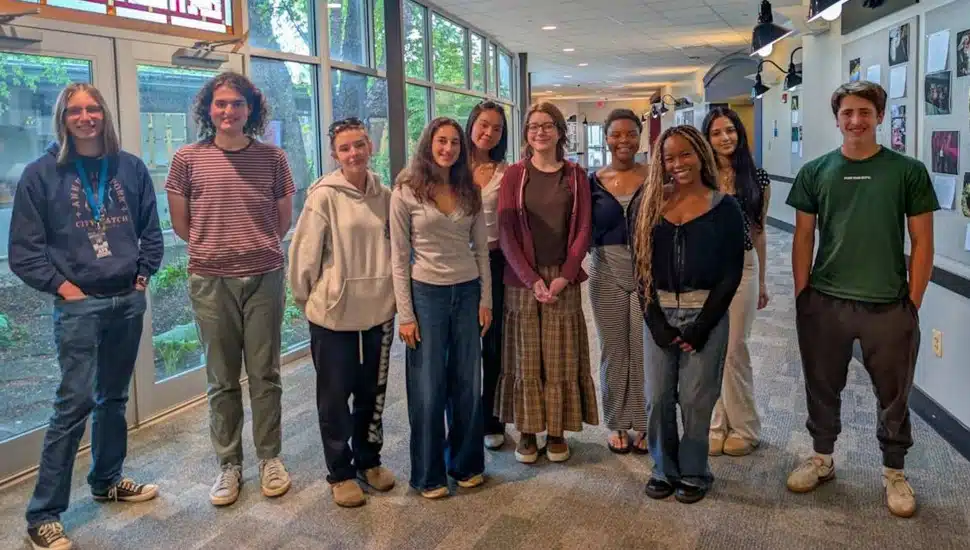
For Abington Friends School senior Sam Calandra-Jayne, the topic of phones in school brings up strong opinions. A reflective writer, wrestler, and student journalist, he saw AFS’s new Upper School policy requiring phones to be placed in Yondr pouches as an opportunity. It raised questions — and he turned to the student newspaper, The Blue and White, to explore them.
“I think it’s the piece I’m the proudest of for a lot of reasons,” said Calandra-Jayne. “I got to talk to (Upper School Director) Brendon (Jobs), I did a lot of research, and I personally think that it was one of my better written articles. But I also had many of my personal questions answered, some in satisfying ways and some not so much. More than just writing something and putting it out, I learned a lot from writing that article.”
In an era shaped by the constant flow of information, journalism can play a key role in teaching students about the information environment and how their voices shape it. Reporting, interviewing, and fact-checking require students to make decisions about credibility and evidence in real time, which helps strengthen research skills as well as digital media literacy. For Calandra-Jayne, that meant speaking with students, interviewing administrators, and researching the system being adopted. Bringing those elements together into a single article is challenging on its own. Add deadlines for layout, photography, and editing, and the work becomes even more complex. It’s one reason colleges increasingly value students who can navigate information with care and precision.
Upper School English teacher Daniel Benjamin, who serves as faculty advisor for The Blue and White, helped guide the paper’s founding in 2023. Having advised newspapers at several schools, he has seen how student organizations rise to meet these challenges.
“I think there’s a unique opportunity that student newspapers have, where students can lean into a certain authenticity of voice and style,” said Benjamin. “But there is also this opportunity for students to mentor one another. One of the true joys of my journalism class is taking advantage of the experience and leadership of students and leveraging them, so that they can be teaching and supporting their peers.”
In his classroom, experienced student editors work alongside newer writers, guiding revisions and shaping the reporting process. This structure reflects research showing that students deepen their understanding when they teach others — and become more critical consumers of media in the process.
Liam Hilliard, a senior and the Lead Features Editor, considers developing student agency and voice the cornerstone of his student newspaper experience and the most important element to foster as an editorial team at the school.
“I think it really needs to be fostered for the element of free speech, free expression,” he said. “And so that’s what keeps me coming back. I really want to see this newspaper succeed.”
When student leadership graduates, some organizations lose momentum. But The Blue and White has continued to grow. Founders Orla Maxcy and Miranda Shandell earned a Gold Circle Award from the Columbia Scholastic Press Association, and students have received Best of Student News Online recognition.
More recently, the paper earned recognition from the National Scholastic Press Association, with Calandra-Jayne, Hilliar, Ash Cohen, Kylie Firmin, Serafina Kubersky, Oonagh Moore, Alana Son, Anjali Tremblay, and Lauren Washington honored with the Leadership Award in Student Journalism. That success is not accidental.
“Newspapers are dynamic places where leaders get to grow into their roles,” said Benjamin. “And this year, there’s a strong team of senior leaders who work really hard to guide the practice.”
Meeting twice a month, the editorial team coordinates assignments, manages deadlines, and balances coverage across topics. Each editor shapes a different part of the paper: Son leads sports coverage, Hilliard supports developmental editing, and Firmin focuses on photography and visual storytelling.
The paper also gives students space to voice their opinions — both positive and critical. When Upper School was considering adopting the phone-free policy, The Blue and White published several student perspectives on the question. But more than his opinion, Calandra-Jayne was focused on how to report on it well.
“It’s something that Daniel talks a lot about,” he said. “When writing news articles, I try to be as neutral as possible, but it’s going to be impossible in every situation. There’s always forms of bias that sneak into reporting. So, Daniel really encourages us to just get out there and write. We get the basics, how to write from a journalistic lens, how to interview people, but he also gives us space to figure it out ourselves.”
“AFS students are especially great at recognizing how writing for an authentic audience is more valuable than writing just for your teacher,” said Benjamin.
That freedom often leads students in unexpected directions. Washington conceived of a deeply reported feature on labubus — those cute and terrifying felted creatures that clip onto children’s backpacks all over the world. But from reporting standards, it goes deep.
Washington spoke with Upper School science teacher Katie Livingston about the environmental impacts of toys and overconsumption. She spoke to Director of Student Support & Wellbeing Mike Cassano about the psychology behind shopping for a toy that matched the trend. And she went straight to the source — third and fourth graders — to ask them why they loved these furry, long-eared creatures in the first place.
“Interviewing the third and fourth graders at first was a little bit complicated because I could tell they weren’t comfortable with me because I was a stranger,” said Washington. “But after a while, they really started to open up and get really excited. I could tell that through their body language and how they would light up when talking about a labubu.”
Pursuing this story was something Washington chose for multiple reasons, not the least of which because she loves interacting with younger students. Certainly, she loves the thrill of mapping such an ambitious idea onto the page, but as an aspiring pediatrician, she also feels like it is preparing her for a future career — even if it isn’t in journalism.
“This was the longest article I’ve ever written,” she said, “and I felt I really challenged myself, and I was proud of my work when the article came together with the pictures and everything.”
That sense of pride really only comes from ownership of the writing process, from beginning to end.
“It’s not like history where I don’t often have access to live sources, or English, where I have to write about a book,” said Calandra-Jayne. “I can explore almost any topic that I want to: sports, or technology, or politics. There’s a sense of freedom that isn’t the same in other classes.”
Journalism at AFS also connects to the school’s culture in quieter ways. Several students describe getting ideas during Meeting for Worship, which sometimes constitute the only moments when they have time to sit with a question or a passing thought for an extended period to see where it leads. That habit carries into their writing. Rather than rushing to a conclusion, they learn to listen closely, consider different perspectives, and shape their ideas with care. In that sense, the process of reporting and writing begins to mirror something familiar: pausing, noticing, and then speaking with intention.
“A lot of the ideas that I have for articles actually come from Meeting for Worship because that’s the time I reflect the most,” said Son. “I’m such a thinker, so that’s the time that I have time to digest all of my thoughts.”
For Moore, the element that most enriches the journalism experience is the one-on-one interview, a powerful skill in the journalist’s repertoire that can transform casual conversations into moments of insight.
“In every article I’ve written, even if it isn’t a feature, the interview has been my favorite part,” she said. “I love combing through the transcripts, digging for quotes. I think I interview Amy (Diaz-Newman) a lot because I’ve definitely built a very strong relationship with her, and I think that is because of my appreciation for art and the fact that I’ve taken so many of her classes. But with journalism, it’s slightly different than art.”
Moore’s work in art, whether it’s carefully articulated linework on a portrait with oils or the tender kneading of clay in ceramics, informs her journalistic sensibilities without overwhelming them. The interview becomes a conversation that shapes the piece, grounded in both attention and interpretation. In her award-winning article “Defund the Curl Police,” she spoke with seven different students (and Diaz-Newman) about internet trends around curly hair, trying to get at the different ways that the term “curly hair” impacts one’s everyday life.
“It’s a huge process, but I like the details,” said Moore. “I like to do a lot of research, I like to use hyperlinks and other sources in the articles, and I think it’s cool when you can relate a quote to another source. And I just like talking to people. Going through the transcript. Picking out what quotes I’m going to use.”
It’s a simple idea, but it shows up everywhere in the work: start with a conversation, listen closely, and build from there. And in between deadlines, interviews, and edits, what remains is the simple joy of it: students talking through ideas, laughing over drafts, and seeing their work published for others to read. It’s a small newsroom, but an active one, where writing feels alive and shared, and where each issue reflects the voices of the students who made it.
Learn more about Abington Friends School and how it cultivates intellectual excellence, fosters strength of character, and supports the growth of each student’s unique talents.