
As the world looks to NASA’s Artemis missions — returning humans to the moon’s orbit and laying the groundwork for deeper space exploration — students at Abington Friends School are also learning to see the universe in new ways.
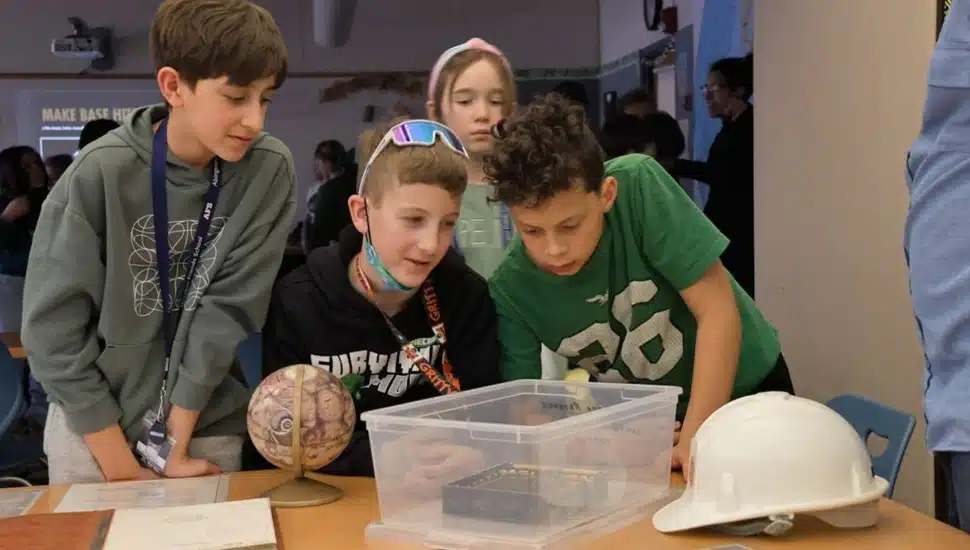
Fifth and sixth graders recently welcomed a special guest: Andee Mazzocco, who shared stories of her father’s work on the Voyager 1 mission. Voyager, launched in 1977, remains one of humanity’s most ambitious journeys into the unknown, now traveling through interstellar space nearly 50 years later.
Holding artifacts and hearing firsthand accounts from that era, students were invited to consider both the history and the future of space exploration from Voyager’s distant path to Artemis’s renewed push outward.
Before Mazzocco’s visit, students had been exploring a deceptively simple question: What do we really see when we look at the stars?
While constellations appear flat and fixed from Earth, the reality is far more complex. The stars that form familiar patterns in our night sky are not neatly arranged on a single plane. They can be trillions of miles apart, separated by vast distances we don’t perceive.
To bring this idea to life, students created 3D Constellation Boxes.
Each student selected a constellation and recreated it inside a shoebox. From the front, the constellation appears just as it does from Earth, recognizable and aligned. But from the side, the illusion disappears. Stars jut forward and backward at dramatically different distances, revealing a structure that looks entirely different from any other perspective.
To make their models accurate, students worked with real astronomical data, converting distances measured in light years into centimeters. (For context, one light year equals about 5.9 trillion miles.) Compressing such immense scales into a shoebox required both mathematical precision and creative problem-solving.
“When looking at a constellation box, you have to close one eye and position yourself just right so that the 3D stars line up with the picture of the constellation behind it,” said middle school teacher Anya Rose. “That’s what is happening with us on Earth! If we were anywhere else but Earth, the stars would look completely different.”
At AFS, students are encouraged to question perspective, to recognize that what they see is shaped by where they stand, and to remain open to new ways of understanding the world. Whether studying the cosmos or engaging with one another, this habit of mind guides learning. As always, space exploration invites us to look outward, look more closely, look again and again, and more carefully at what may seem familiar.
Learn more about Abington Friends School and how it cultivates intellectual excellence, fosters strength of character, and supports the growth of each student’s unique talents.