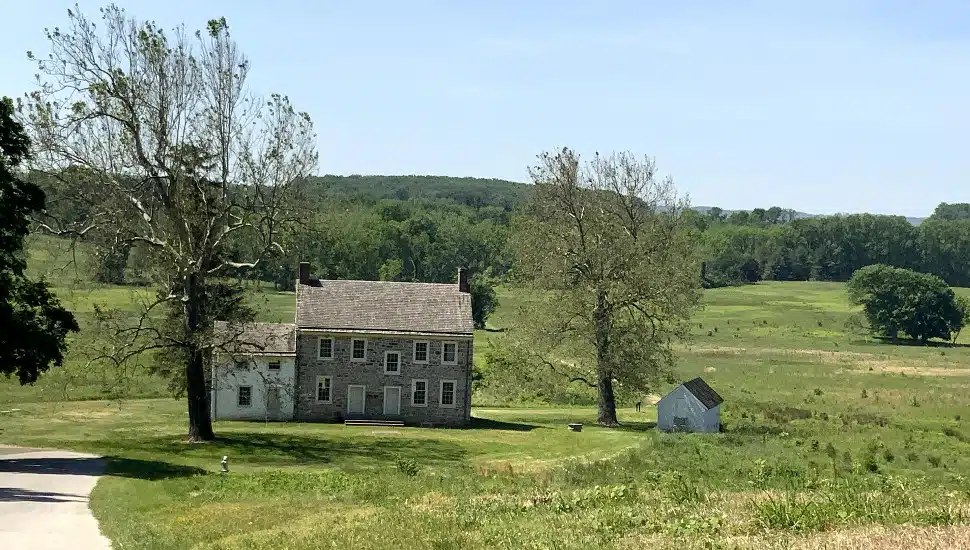
Before the world called it the American Revolution, it began right here along the Delaware River, across the rolling farms of Chester County, and in the cobblestoned streets of Philadelphia.
From Brandywine River to Germantown, the British Army and General Washington’s American forces fought for control of a region that would determine the fate of a nation.
While Valley Forge has become synonymous with courage and endurance, it was not the scene of a battle.
During that bitter winter encampment, Washington’s army, hungry, cold, and undertrained, was reborn under Baron von Steuben’s drilling.
The American army that marched out of Valley Forge in the spring of 1778 would soon prove itself on the fields of Pennsylvania, New Jersey, New York and beyond.
Before Washington’s army hunkered down at Valley Forge, the war swept through southeastern Pennsylvania in a series of fierce clashes that tested both sides’ resolve.
Here are ten of the most pivotal battles, near-battles, and skirmishes fought within 30 miles of Philadelphia.
Battle of Brandywine – Chadds Ford (September 11, 1777)
The Battle of Brandywine was the largest engagement of the Revolutionary War, pitting nearly 30,000 soldiers against one another.
General Howe led British regulars and Hessian forces in a complex flanking maneuver that forced Washington to retreat toward Philadelphia.
Though it was not by any measure an American victory, the battle proved the Continental Army’s determination to stand against the world’s most powerful British forces.
Battle of Germantown – Philadelphia (October 4, 1777)
Weeks later, Washington launched an audacious assault on British troops encamped in Germantown.
Confusion and heavy fog turned the fight into chaos, but the attack impressed foreign observers, including the French court, and helped pave the way for France’s support of the revolution.
Battle of Paoli (Paoli Massacre) – Malvern (September 20–21, 1777)
Under the cover of darkness, British regulars stormed Anthony Wayne’s encampment near Paoli with bayonets fixed.
Dozens of Americans were killed before they could fire a shot. The “Paoli Massacre” became a rallying cry throughout the colonies.
Battle of the Clouds – Frazer (September 16, 1777)
A massive thunderstorm ended this near-battle before it began, drenching gunpowder and saving both sides from destruction.
Washington withdrew his American force toward Yellow Springs, narrowly avoiding another devastating loss.
White Horse Tavern Skirmish – Frazer (September 1777)
Only days before the Paoli attack, scattered clashes erupted around taverns and crossroads as both armies maneuvered for position.
The British Army’s disciplined scouts kept pressure on Washington’s retreating men.
Birmingham Hill – Chester County (September 11, 1777)
Part of the Brandywine River fighting, Birmingham Hill saw some of the bloodiest combat of the campaign.
For hours, Hessian forces and American soldiers fought hand-to-hand before Washington’s line collapsed under superior numbers.
Battle of Barren Hill – Lafayette Hill (May 20, 1778)
As Washington’s army recovered at Valley Forge, Marquis de Lafayette led a reconnaissance force that found itself surrounded by the British army.
Using quick thinking and the local terrain, Lafayette escaped—a small but symbolic American victory.
Battle of Crooked Billet – Hatboro (May 1, 1778)
In Montgomery County in what is current day Hatboro, Colonel John Lacey’s militia was ambushed by British troops and loyalist cavalry.
Lacey’s men were scattered, but their resistance helped protect the countryside north of Philadelphia from enemy raids.
Skirmish at Downingtown – Chester County (September 1777)
During the Philadelphia campaign, British forces captured a convoy of American supplies bound for Chadds Ford and the Battle of Brandywine.
The loss underscored the logistical struggle Washington faced against a far-better-equipped opponent.
Pickering’s Ford Skirmish – Near Valley Forge (Late 1777)
While no battle raged at Valley Forge itself, British foragers and American pickets clashed along the Schuylkill River, testing nerves on both sides.
It was a reminder that even during the army’s harsh winter, the war never truly paused.
The Revolution Happened Right Here
The American Revolution wasn’t some far-off war fought in another time and place. It happened right here, in our neighborhoods, in our towns, along the banks of our creeks and rivers, and in our farm fields.
From the banks of the Brandywine River to the taverns of Frazer and the quiet streets of Hatboro, ordinary Pennsylvanians watched armies march past their doors and history unfold outside their windows.
These places aren’t just names in a textbook. They’re places that are still part of our everyday lives.
Walk those roads today and you’re walking through the Revolution itself. It wasn’t born in a single battle or a grand speech, it was forged, step by step, across the towns and counties we call home.
__________
Historian Garry Adelman gives a presentation on the history of the Revolutionary War in America.