Most Americans know Valley Forge. The brutal winter. The frozen soldiers. Washington holding his army together by will alone. But ask what happened before Valley Forge, or why the army was even in this corner of Pennsylvania, and the story goes quiet.
The answer is Montgomery County.
To understand why Washington kept returning to this ground, look at the map. Montgomery County sat at the intersection of everything the Revolution depended on: British-occupied Philadelphia to the south, Schuylkill River crossings threading through its center, overland supply routes connecting the Continental Army to the rest of the colonies, and iron furnaces along the river producing the cannon and shot that kept the army armed.
Whoever controlled this county controlled the strategic balance of the Philadelphia campaign. Washington knew it.
So did the British.
Within Montgomery County’s borders, the army marched, camped, fought, and was ultimately transformed. Washington used its farmhouses as command centers. Its iron forges armed the revolution.
Churches became field hospitals. German farming families fed 12,000 soldiers through two desperate seasons.
And in one of its finest estates, a loyalist’s wife was secretly carrying messages to the other side.
As America marks its 250th anniversary on July 4, 2026, fifteen sites across the county preserve that full story, most within thirty minutes of each other and Philadelphia. Here is the trail.
The Encampments
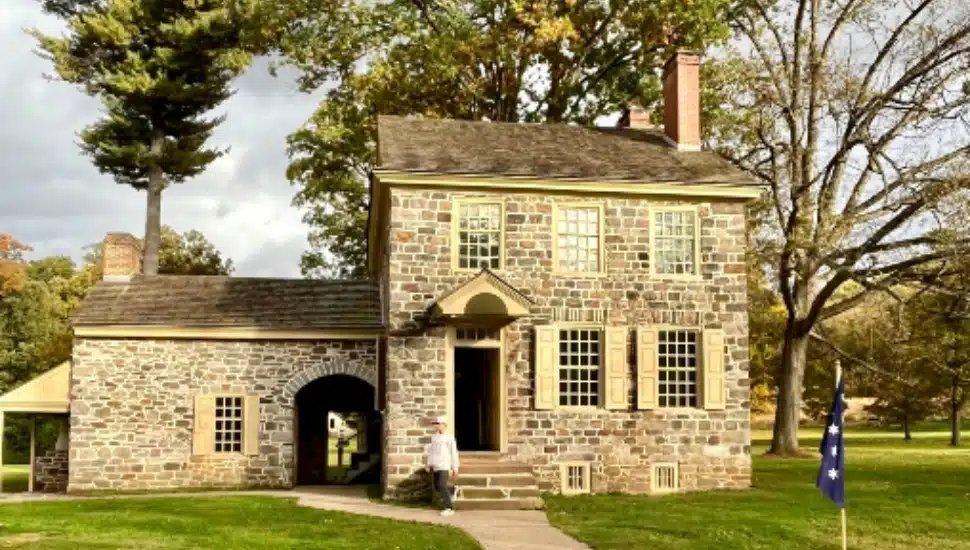
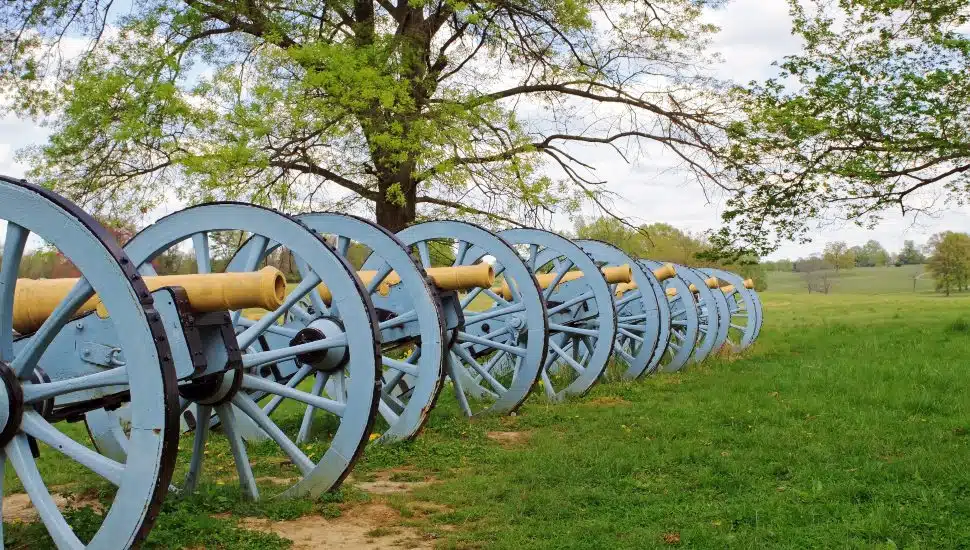
1. Valley Forge National Historical Park: The anchor. In December 1777, Washington led 12,000 soldiers into the hills along the Schuylkill. Six months of cold, hunger, and disease followed, and then, under Baron von Steuben’s drilling, a transformation.
The ragged force that arrived became something approaching a professional army by spring. The 3,500-acre park preserves it all: reconstructed huts, Washington’s Headquarters in the Isaac Potts house, earthworks, and trails. Free to enter. Plan three hours minimum.
2. Fort Washington State Park / The Whitemarsh Encampment: The forgotten chapter. Before Valley Forge, Washington spent a month encamped on the high ground of Whitemarsh, with the same 12,000 soldiers dug in on defensible hills and British-held Philadelphia visible to the south. When General Howe marched out on December 5th to dislodge them, Washington’s position held.
Three days of skirmishing and the British retreated. On December 11th, the army broke camp and marched to Valley Forge. This is the direct prequel to the story everyone knows, and it happened entirely within Montgomery County. No original structures remain, but 3.5 miles of trails cross the same terrain, and the topography still tells the story.
3. Peter Wentz Farmstead: Washington’s headquarters before and after the Battle of Germantown. It was in this Pennsylvania German farmhouse that he finalized the plans for a surprise assault on October 3, 1777, and here, days later, that he learned of the British surrender at Saratoga.
Meticulously restored to its 1777 appearance, with guided tours and living history demonstrations.
4. Skippack / The Indenhofen House: One of the oldest farmsteads in Pennsylvania, circa 1713, where Washington’s army camped along Skippack Creek before Germantown. Skippack Pike itself, still drivable today, was a primary Continental Army corridor throughout the campaign.
5. Pennypacker Mills: Washington used Samuel Pennypacker’s home as a headquarters after Germantown. Today, a county historic site housing more than 20,000 artifacts reflecting the Pennsylvania German heritage the army moved through.
The Headquarters and Estates
6. Hope Lodge, Fort Washington: A Georgian stone mansion that served as the headquarters of Dr. John Cochran, Surgeon General to Washington, during the Whitemarsh Encampment. One of the finest colonial houses in Pennsylvania, open for tours and home to an annual Whitemarsh reenactment each November.
7. The Emlen House, Fort Washington: Washington’s personal headquarters during Whitemarsh, a fieldstone Quaker manor built in 1717. The building is private, but a Pennsylvania historical marker marks the site.
8. Graeme Park, Horsham: The most compelling human story on the trail. The estate was owned by British loyalist Henry Hugh Fergussen, who used his wife, Elizabeth, to carry secret messages to Washington. The colonial government seized the property. The manor house is open for tours.
9. Historic Trappe and the Muhlenberg Sites: The Muhlenberg family produced the first Speaker of the U.S. House, the first signer of the Bill of Rights, and a Patriot general. Three sites in Trappe preserve their story: the Speaker’s House, the Henry Muhlenberg House, and Dewees Tavern.
The Home Front
10. New Hanover Lutheran Church: Used as a Continental Army hospital after the Battle of Brandywine. Fifty Revolutionary War soldiers are buried in the cemetery.
11. Plymouth Friends Meetinghouse: In continuous use since approximately 1708, one of the oldest active houses of worship in the country. Served as a hospital and campsite on the march to Valley Forge.
12-14. The Farming Communities, Iron Furnaces, and Pottsgrove Manor: The Pennsylvania German farmers supplied the food and labor that kept the army alive. The Potts family’s iron forges, including the one that gave Valley Forge its name, supplied the ammunition. Pottsgrove Manor in Pottstown tells that industrial story in full.
The Roads Themselves
15. Skippack Pike, Bethlehem Pike, Germantown Pike: The final site is the road beneath your tires. These routes, still drivable today, are the corridors Washington’s army used across the whole campaign. Blue and yellow Pennsylvania historical markers line the way. Stop when you see them.
Plan Your Visit
Valley Forge NHP is free. County sites charge modest fees; the Montco History Pass bundles access. America 250 programming is expected throughout 2026, with the largest events at Valley Forge around July 4th. A car is essential, as most sites are within 20 minutes of each other.
Two hundred and fifty years on, all fifteen stops are still here. Go walk them.