Before Montgomery County’s suburbs were shaped by highways, shopping centers, and office parks, many of its most recognizable towns were built around something simpler: the train station.
That history still matters. In many of the county’s old railroad towns, the same compact layouts that once served commuters, workers, farmers, and small businesses now make them some of Montco’s best walkable destinations.
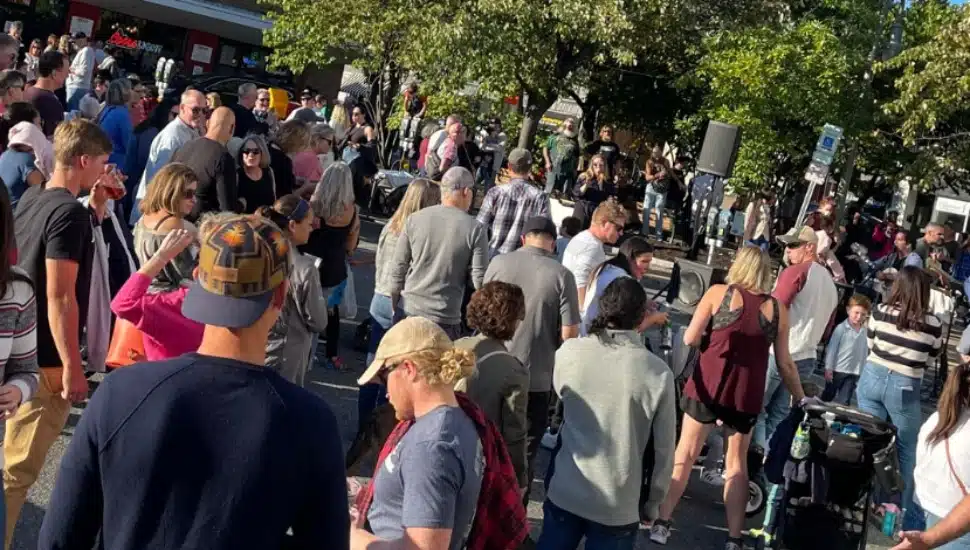
A walkable town is not just a place with sidewalks. It is a place where visitors can park once, or arrive by train, and spend a few hours exploring without ever needing to get back in the car.
The best examples offer restaurants, coffee shops, bars, boutiques, theaters, parks, historic buildings, outdoor dining, community events, and something harder to manufacture: a genuine sense of place.
The Railroad Didn’t Just Serve These Towns. It Created Them.
That last quality is exactly what old railroad towns tend to have in abundance. They were designed around arrival.
Businesses clustered near the station because that was where people came and went. Over time, those centers filled in with shops, restaurants, offices, homes, churches, banks, civic spaces, and entertainment.
In many cases, the railroad did not just serve these towns. It created them.
The Pennsylvania Railroad’s main line of public works gave the region its most famous address. Towns along that corridor were platted, named, and in some cases literally renamed by the railroad to attract riders and settlers.
That is not just history. It is the blueprint for everything these downtowns still are today.
The Towns Worth Visiting Today
Today, towns like Ambler, Lansdale, Ardmore, Narberth, Conshohocken, and Jenkintown show how that old railroad DNA can still shape modern suburban life.
Ambler: The Full Package
Ambler has one of the county’s most complete downtown experiences. Butler Avenue offers a classic park-once-and-explore afternoon, with restaurants, bars, coffee shops, boutiques, salons, fitness studios, historic buildings, outdoor dining, and a community events calendar that runs year-round.
The street is also home to two professional theaters operating side by side: the Ambler Theater, a nonprofit arthouse cinema that has anchored the downtown since 1928, and Act II Playhouse, a 130-seat professional stage company producing new, classic, and contemporary plays and musicals.
Few boroughs this size anywhere in the Philadelphia suburbs can claim that kind of cultural depth on a single block.
While there: check out Ridge Hall for a modern food-hall experience and Bridget’s Steakhouse for polished dining in the heart of Ambler.
Lansdale: The Comeback Story
Lansdale may be Montco’s strongest railroad-town comeback story. The train station still anchors the borough’s center. Surrounding it is a downtown that has been rebuilt with real energy. It has a restored freight house, the iconic Kugel Ball at Railroad Plaza, breweries, restaurants, shops, parks, public art, new apartments, First Fridays, and a full calendar of festivals and seasonal events.
Lansdale kept its railroad bones and built something modern around them.
While there: check out Stove and Tap, a lively downtown Lansdale favorite for brunch, dinner, drinks, and gathering with friends.
Ardmore: Where the Railroad Left Its Clearest Mark
Ardmore is perhaps the clearest proof of how completely the railroad shaped these communities. The town was known as Athensville until the Pennsylvania Railroad renamed it Ardmore in 1873 to market the corridor to Philadelphia commuters.
When Suburban Square opened in 1931 on the north side of the tracks, it became one of the first planned suburban shopping centers in the country, built to capture the foot traffic of arriving rail passengers.
Today, Lancaster Avenue, Suburban Square, and Ardmore Music Hall together make it one of the most layered and walkable downtowns on the Main Line.
While there: check out Ripplewood Whiskey and Craft for cocktails and elevated pub fare. Then, stop by Delice et Chocolat for French pastries and coffee.
Narberth: Small Borough, Big Character
Narberth offers something smaller and harder to replicate. It is a genuine village tucked inside the Main Line. Restaurants, cafes, shops, bakeries, salons, community spaces, parks, train access, and a fiercely local identity resist the generic.
It is the kind of town people mean when they say they want to live somewhere with character.
While there: check out Narberth Park, a beloved borough gathering spot that captures Narberth’s small-town, family-friendly feel.
Conshohocken: From Steel Town to Destination
Conshohocken has the most dramatic origin story of any town on this list. This was once a major steel and manufacturing center along the Schuylkill River, a hard-working industrial borough built on mill labor and heavy industry.
That world is largely gone, replaced by Fayette Street’s thriving lineup of restaurants, bars, cafes, fitness studios, offices, and apartments.
What remains is the bones: the rowhomes climbing the hillside, the river below, and the Schuylkill River Trail threading through it all and connecting Conshohocken to communities up and down the valley.
The industrial past did not disappear. It became the character.
While there: check out Hotel West and Main for stylish downtown energy and Skytop Garden at The Great American Pub for rooftop drinks and views.
Jenkintown: Classic Small-Borough Charm
Jenkintown rounds out the list with the kind of small-borough charm that is increasingly hard to find. Its compact downtown has restaurants, cafes, shops, salons, fitness studios, historic buildings, tree-lined streets, civic landmarks, the Hiway Theater, and access to the Jenkintown-Wyncote station, one of the most-served commuter rail stops in the Philadelphia region with four SEPTA lines passing through.
While there: check out West Avenue Grille for breakfast or brunch, then catch a movie at the Hiway Theater, Jenkintown’s community cinema landmark.
Still Built for Connection
These towns were built for connection. They once connected people to trains, jobs, markets, and each other. Today they connect visitors to food, culture, history, shopping, and the kind of local character that no highway corridor or shopping center has ever managed to replicate.
Montgomery County’s railroad towns are not just reminders of the past. They may be the best model the region has for what a suburban downtown can actually become.