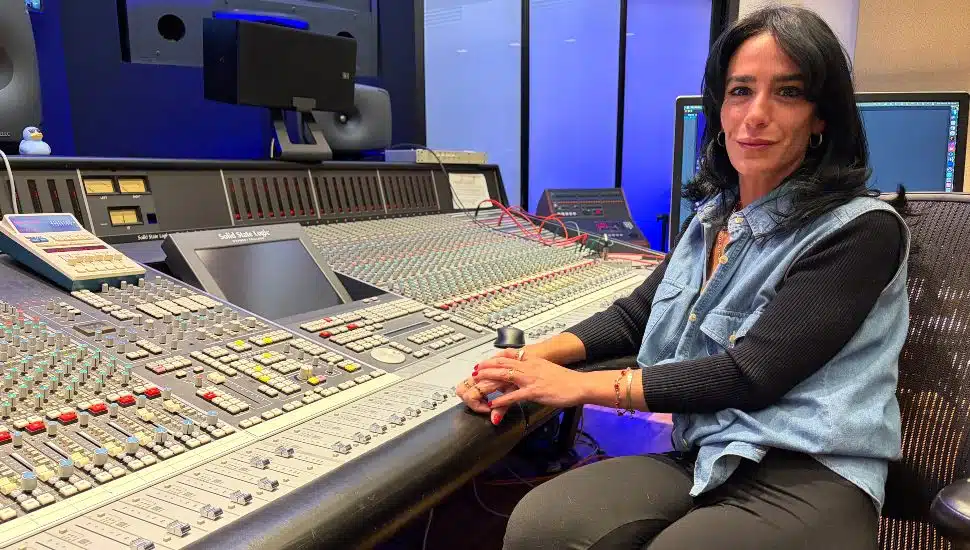

When Mia Fanelli listens to music, she doesn’t just hear it — she sees it.
Colors, shapes, images. Sometimes textures. Occasionally, even tastes.
That’s chromesthesia: a neurological phenomenon in which sound involuntarily evokes an experience of color, shape, and movement. It’s thought to stem from atypical brain connections, where regions responsible for processing sound are unusually linked with those involved in color perception. It affects an estimated one percent of the world’s population — and for Fanelli, a 37-year-old Sound Recording and Music Technology (SRT) major at Montgomery County Community College, it turned out to be the seed of a patent-pending invention that could reshape the Audio Engineering industry.
Introducing OHLA
Fanelli has developed OHLA (Opto Haptic Linear Attenuator), an accessibility technology for Audio Engineers that allows users to both see and feel audio levels directly through a mixing board fader — without ever having to look away from the screen.
The problem she was solving is deceptively simple: audio engineers are constantly splitting their attention. Their hands are on the faders. Their eyes are on the monitor. Then they reach for the mouse. Then back to the board. It’s a workflow that’s barely changed in decades, and one that’s entirely inaccessible for Engineers with visual or hearing differences.
“You’re able to just move your fingers and have all the information right there if you don’t necessarily have the ability to see,” Fanelli said. “Or if you can see but you don’t have the ability to hear, you can still use this tool in a way that will give you the information that everyone else is getting. I really wanted to create a tool that meets people where they are.”
The inspiration struck in MCCC’s Mix Room on the Blue Bell Campus, during a conversation with David Ivory, Director of Sound Recording and Music Technology.
“We were discussing how audio recording tools haven’t evolved over time,” she said. “The way we raise the volume or pan audio has always just been the same as it’s been for the last century.”
For Fanelli, chromesthesia makes every listening session a full sensory event, as she explains that she sees almost whole movies play in front of her when she hears music. With that, the constant visual distraction of looking back and forth across the studio was a real obstacle. She needed a center of focus. She started designing one.
“I soon realized nobody had ever done it before,” she said.
Six Weeks. Two Patents. One LLC.
Fanelli conceptualized, coded, and built a working OHLA prototype during the 2025 winter break — a six-week sprint from Dec. 24 to Feb. 4. In that same window, she filed two patents (one for the hardware, one for the algorithm) and formed an LLC. She’s since conducted functional demonstrations for influential figures in the professional audio industry, and her phone hasn’t stopped ringing with investor interest.
“I approached David Ivory after I had completed everything and made sure everything worked,” she said. “He encouraged me greatly from the moment I told him and has assisted in many aspects.”
The Non-Traditional Path That Led Here
Fanelli didn’t arrive at MCCC as an inventor. At 35, she left a sales job at a local winery and enrolled as a Computer Science major — curious, searching, not quite sure where she was headed.
“Programming was not as fulfilling for me,” she said. “I wanted to see what I was doing more, in a way, and feel it.”
Three classes in, she switched to Sound Recording and Music Technology, and everything clicked. She taught herself harp, piano, and ukulele. She earned Dean’s List honors five semesters in a row. She was awarded the prestigious WSDG (Walters-Storyk Design Group) Excellence Scholarship, given to academically excellent SRT students demonstrating financial need.
She also found the kind of faculty support that doesn’t show up on a brochure.
“Michael Kelly was the very first Professor I met with who just kind of encouraged me in a way that I hadn’t experienced,” she said. “He, David Ivory, and Howard Gordon are my main influences here, and they are such a support system.”
Kelly didn’t mince words when describing what she’s accomplished.
“Mia’s achievements reflect the highest standards of scholarship, creativity, and perseverance,” he said. “Watching her grow into someone who believes in her own work and its impact has been one of the most rewarding experiences of my career. She represents the very best of our Sound Recording and Music Technology program.”
This spring, Fanelli graduated from MCCC and heads to Berklee College of Music to continue her studies — carrying two patents, a growing roster of industry contacts, and a technology that didn’t exist two years ago.
Curious what’s possible at Montco? Whether you’re 18 or 38, exploring for the first time or starting over, MCCC has the programs, the faculty, and the space to help you find your thing. Visit MCCC online to explore degrees, scholarships, and everything the College has to offer.

About Our Partner
Montgomery County Community College
Montgomery County Community College exists to open doors. With more than 100 degree and certificate programs, two campuses rooted in the heart of Montgomery County, and a track record of sending graduates into careers and four-year universities, MCCC is where neighbors become nurses, business owners, and engineers. It’s where the Philadelphia region comes to learn, grow, and give back.
Learn more