Most college students pick a school and stay there. At Bryn Mawr and Haverford, that’s never really been the point, writes Susan Snyder for The Philadelphia Inquirer.
The two Main Line liberal arts colleges, separated by about a mile and a five-minute shuttle ride, have spent decades building one of the most seamless academic partnerships in American higher education.
Through the Bi-College connection, students can take classes, join clubs, use facilities, eat in dining halls, and even pursue majors across campuses without paying a dollar more in tuition.
It’s a setup that sounds almost too good to be true. For students at both schools, it’s just Tuesday.
A Shuttle Ride Between Two Worlds
In fall 2025, 40% of Bryn Mawr students took courses at Haverford, while 42% of Haverford students enrolled in classes at Bryn Mawr.
Altogether, the semester logged more than 1,700 course registrations on non-home campuses, a figure that speaks to how deeply the partnership is woven into everyday student life.
Two Campuses, One Academic World
The arrangement lets both colleges stay small while offering something much larger. Joint and shared programs have helped sustain fields that would be difficult and expensive for either school to support alone.
Neuroscience, architecture studies, languages, theater, music, art history, and other interdisciplinary areas all benefit from the combined resources of both institutions.
It also gives students access to what the other campus does best. Bryn Mawr brings art history, theater, a pool, and the distinctive culture of one of the country’s most respected women’s colleges.
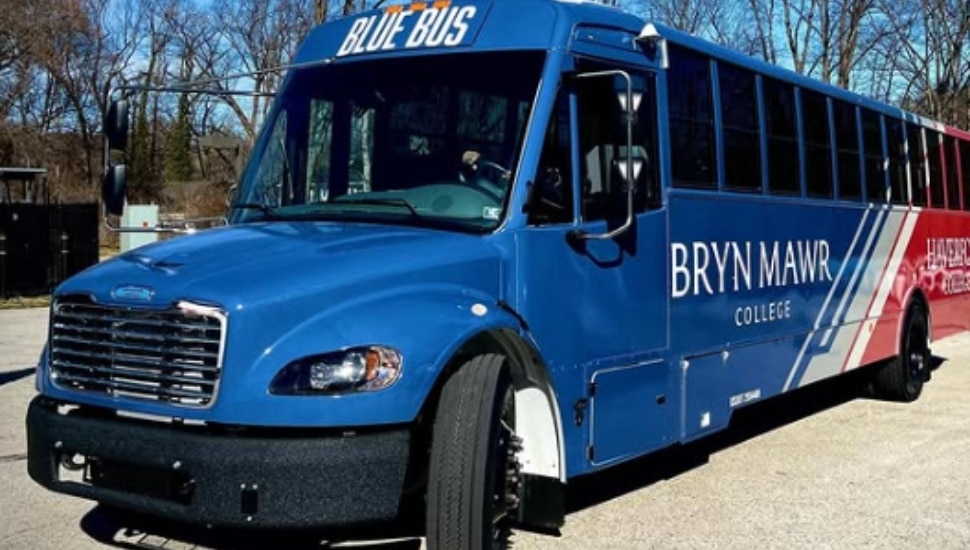
Haverford contributes music, fine arts, and a track. The Blue Bus connects them, running throughout the day so a student can take a morning class on one campus and an afternoon seminar on the other without breaking stride.
That kind of flexibility has a way of reshaping how students think about their education. Rather than working within the limits of a single institution, students at both schools move through a combined academic world.
They choose courses, communities, and experiences from a much wider menu than their enrollment paperwork might suggest.
A Partnership Built to Last
College leaders recently renewed a Collaborative Compact, marking 50 years of the partnership, framing the agreement around a simple idea: each institution is stronger because of the other.
The renewed compact, covering 2026 through 2031, outlines priorities around cross-campus curriculum, coordinated advising, and shared infrastructure.
For students, the result is something that is harder to put in a brochure but easy to feel on campus.
It is a small-college education, tight-knit, faculty-forward, and deeply personal, with two campuses, a broader course catalog, and more ways to build something that is genuinely your own.
Read more about the decades-long partnership between Bryn Mawr and Haverford colleges in The Philadelphia Inquirer.