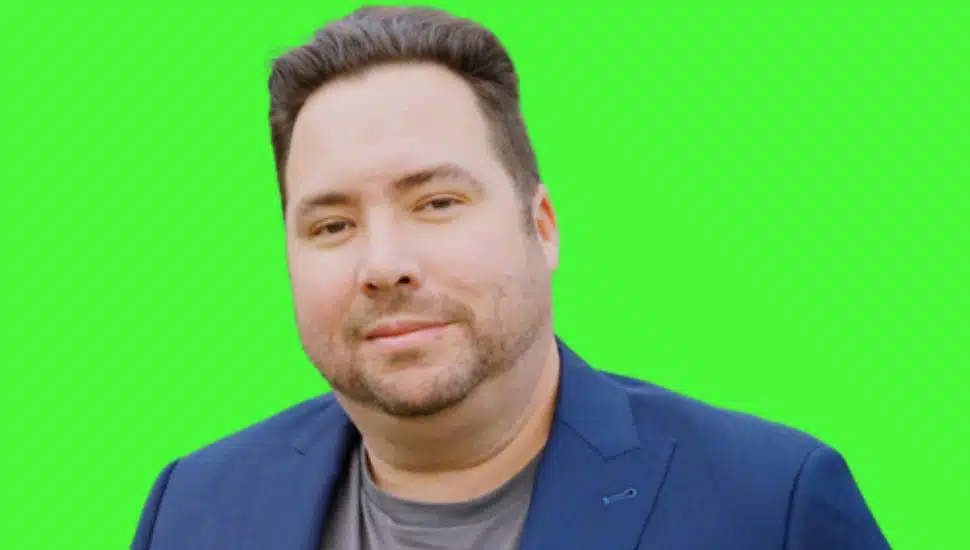
David Fair, Executive Director at Turning Points for Children, spoke with MONTCO Today about growing up attending Catholic school in Southwest Philadelphia, coming out as gay, and discovering his passion for activism while working as a church secretary at a church on the University of Pennsylvania campus.
After many years serving and advocating for people with AIDS, Fair transitioned to working with DHS to protect Black children from over-diagnosis and stigma in the mental healthcare system.
In his role at Turning Points for Children, he now works to reduce crowding in the foster care system by focusing on prevention and family outreach.
Where were you born, and where did you grow up?
I was born and grew up in Southwest Philadelphia, right near the corner of 57th and Kingsessing, which was the epicenter of a neighborhood of Italian and Irish Catholic families. I was a block away from the closest Catholic elementary school, Most Blessed Sacrament School, which had the largest student body of all Catholic schools in the country, almost 4,000 kids.
We had 120 kids in my first-year class, and there was one little nun who somehow managed all of us.
What did your mom do, and what did your dad do?
My mother took care of us. My father worked at the Atlantic Refining Company, then got laid off and worked at the Navy Yard. He carved his initials into one of the ships, and that piece of that ship later ended up at The Franklin Institute.
He went to work before we got up for school, came home to nap, and then woke up when we were going to bed. He was a drinker and died of a heart attack when I was 10.
I didn’t know him very well. I only remember two conversations with him. I remember watching a World Series game with the Pittsburgh Pirates when Bill Mazeroski hit his famous home run to beat the Yankees, and I asked if he had ever seen anything like that. He said he hadn’t, because he was a Phillies fan, and that never happened.
Then, a couple of years later, I ran upstairs while he was in the shower and said, “Art Mahaffey struck out 17 players today in the game!” And he said, “Jesus, Mary, and Joseph!” I was never sure whether he said it because I surprised him or because Art Mahaffey struck out 17 players.
Where were you in the pecking order?
I was the sixth of eight: I had five brothers, three sisters. My oldest brother was 11 years older; six of us are still alive.
Did you have any jobs when you were growing up?
My first job was for a company that was way ahead of its time, called Dento-Medical Tapes. My older brother worked there, and he got me a job when I was 14. They made audio tapes of articles from dental magazines and sent them out as a subscription. I worked there for a couple of years, making $1.12 an hour, and I gave it all to my mother. My brother did the same.
When I was 15 or 16, my uncle, who worked as a Pressman at the Philadelphia Bulletin, got me a job there as a Messenger. I had never been out of Southwest Philadelphia other than to go Christmas shopping at the department stores in Center City. That job sent me all over the city and suburbs on public transportation, picking up advertising. They paid me $3.60 an hour, and I got to meet all sorts of people.
I kept that job through high school and two years into college. It was one of the best jobs I ever had.
What did you take from those years that stays with you today?
My mother taught us to be responsible and honest. It meant something to be out in the world, without her watching, and still feel that way. I’m responsible for what I’m pledging to do. Starting work at 14 reinforced that.
I also got into politics during that time, largely because there was nothing to do while waiting to drop off the Bulletin except read the Bulletin. It honed my political sensitivity, which became my primary sense of self.
What year did you graduate from high school?
I graduated in 1970, and then I went to Penn. I was supposed to go to La Salle because that was where Catholic boys went. I didn’t like that idea, because La Salle was far from Southwest Philadelphia.
I ran for Student Council President in my junior year, and I would go to my Uncle Bart’s church in Cedarbrook to use his mimeograph machine for my broadsides. He told me that I should not settle for La Salle. He was on a scholarship committee in the Tate administration and got me a scholarship to the University of Pennsylvania that included room and board.
What did your uncle see in you?
He was impressed that I was running for Student Council President, and I asked him why. He said, “All of your brothers and sisters are settling, and you’re not settling.”
I was a B student at Penn, but I was active in the anti-war movement and political stuff. I volunteered as a VISTA volunteer. I worked for the Bureau of Consumer Protection.
Frank Rizzo gave a speech at a parish picnic back in 1969 about how he was committed to keeping the “darkies” from coming into the neighborhood, and that pissed me off so royally. My mother was a Rizzo supporter, but by the time I was at Penn, I was anti-Rizzo, anti-war, anti-this, anti-that.
When you look back on your time at Penn, was it the right choice for you?
It was a better choice for me than a Catholic college, so, yes. And I’m glad I didn’t leave town, because I don’t know how I would have handled not having my network with me.
Looking back over your career, who were the people who saw promise in you and opened up doors for you, after your uncle?
There were a few. I got married as a sophomore. My wife, Sonia, was involved in a lot of the same political activities. We separated four years later, after I realized I was gay.
There was also a church on the Penn campus, St. Mary’s Episcopal Church, that was progressive and active in the anti-war movement. They had two gay priests.
I spent my junior year studying in Stockholm because my draft number was very low. When I got back to Penn, I saw an ad in the student paper for a parish Secretary. Working there, I had control of the mimeograph machine, so I could generate leaflets for all sorts of movements. I got involved in the gay rights movement and a lot of other left-wing stuff.
John Scott, the church Pastor, was very supportive of me. He hired me to be his Secretary, not to start the Philadelphia Lesbian and Gay Task Force, but he let me use the church as my base of operations.
I pulled together a committee of gay people to support Lucien Blackwell, a Black politician running for mayor against Rizzo. Bill Green was also running and eventually won, but my committee was very effective in getting white gay people in Center City to support Lucien Blackwell. Lucien Blackwell was pro-gay, and Bill Green was not.
Lucien’s campaign manager, Henry Nicholas, was so impressed that he asked a friend of mine, Scott Wilds, who worked on the campaign with me, if he wanted to work for him at the hospital workers’ union. Scott didn’t want to, but he said, “It was David who did all this work. I think you should hire him.”
Nicholas hired me, without even meeting me, for a clerical job at the union. Just like at the church, I was able to use the union as a base of operations for my own political activities. The union needed the gay community and white people to support Wilson Goode to be mayor in 1983, and I was able to do that. I got to know Wilson, and through him, a lot of other politicians. He taught me an enormous amount about strategy.
Later, Nicholas also got me a job as the head of the AIDS Activities Coordinating Office for Wilson Goode, because I was torturing Wilson when he was the Mayor for not doing enough about AIDS.
So, how did you make the transition into working with children?
After I ran the AIDS office for two and a half years, I took a job running a drop-in center for mostly homeless people with AIDS. I did that for about five years, and I got burned out.
I called up my friend, Estelle Richman, who was the Health Commissioner, and I said, “Do you think there’s any government job for me? Because I can’t do this anymore.”
She was thrilled that I was going to get out of AIDS, because I was harassing her all the time about it, too. She got me a job running a federal grant to demonstrate that too many Black kids in South Philadelphia public schools were getting diagnosed with serious mental illness just because they acted out at school. It was called the Consultation and Education Specialist Program.
A few years later, another friend of mine, Alba Martinez, became Commissioner of the Department of Human Services, and she asked me to help her develop a division to prevent kids from getting involved in the child welfare system. By that time, Estelle was the state welfare secretary.
John Street was the Mayor, and I had been one of the few gay people supporting him when he ran. I told him, “I want to take this job for Alba.” He said, “Fine,” and gave me a $96 million annual budget. Most of that was state funding, but he had to put up 20 percent to match to make it happen.
I spent the next five years investing that money in alternative, preventative services so that we could divert kids from the foster care system, just as we had from the behavioral health system. The city had one of the highest rates of foster care placement in the country. I hate to say, it still does, because the child welfare system is so reactive. But we were extremely successful in improving it.
And you found a new life for yourself in child welfare?
Yes, but I got burned out on DHS, too. It was a horrendous bureaucracy.
Alba Martinez moved on to United Way and offered me twice my DHS salary to come help her bring it into the 21st century. So, I did that for five years, but United Way was not my cup of tea either. I had to be careful about my politics.
So, I became a consultant. One of my consultant jobs, in 2013, was writing an RFP for DHS that was a whole new approach to child welfare in Philadelphia.
The director of Turning Points for Children called me and said, “I know you wrote the RFP, but would they let you come to work for Turning Points so we could apply for the RFP?” I asked the integrity officer, and she said, “As long as you don’t respond to the RFP, you can do whatever you want at Turning Points.” A year later, Turning Points got two contracts for this reform thing, and two more a year after that. I became the COO of Turning Points, and I’m still there 13 years later.
What are your priorities now, and in the rest of 2025? What are you focused on?
I’m trying to save Turning Points. The child welfare system remains a disaster, even though it’s reformed to some degree.
Turning Points went from a $6 million operation to a $67 million operation because of these foster care contracts. But what nobody thought of, including DHS, was that things go wrong in the child care system, and DHS has immunity, so they couldn’t get sued. Agencies like Turning Points can. We got sued 15 times, which isn’t a lot, considering that it was over 13 years working with 15,000 kids, but we had to get insurance to cover it, and we couldn’t.
So, we had to give those contracts back to the city. We went from a $67 million operation to a $23 million operation.
DHS still has more kids in foster care in Philadelphia than the entire state of New Jersey, but we’re reducing the number. It’s not good for business, but it’s the right thing to do.
We have a robust array of services now. We have services for older youth who are aging out of the foster care system, because DHS ages out 300 kids a year into homelessness, and they wipe their hands of it. We have services for fathers whose children are in the foster care system, because everybody assumes the fathers can be written off. We have a program called Family Finding that lets us look for extended family members to see if they’ll come in. We’re back in the prevention business, which is where my heart was from the beginning.
What do you do with all your free time, David?
I’m on six boards. I love being on boards, especially now, because I’m an old-timer, so they don’t ask me to do much. They just want me to advise on things and make connections for them.
I don’t have the energy to do all the stuff I used to, but I still spend most of my free time doing advocacy work.
Do you read? Any favorite authors?
I read a lot of detective stories. When I was younger, Rex Stout, who wrote Nero Wolfe, was my go-to. There’s a guy named Colson Whitehead. I’m a fanboy of his at the moment. And Walter Mosley writes a series about this Black detective, which I think is fascinating.
Three last questions for you, David. What’s something big that you’ve changed your mind about over the last ten years?
It wouldn’t appear like a big thing to most people, but as a gay activist, I have always been in favor of allowing trans people to be respected and accepted as whatever gender they think they are. The only thing I have ever agreed with Donald Trump on is that I don’t think that transgender males should be active in female sports. That’s an unpopular thing in my community to say.
What keeps you hopeful and optimistic? It’s a crazy world out there.
I felt hopeless when I made my suicide attempt in the mid-’90s, and I don’t want to go back there. I’ve been in recovery for 41 years, and AA keeps me hopeful. I’m not that actively involved in the organization, but people being able to put down drugs and alcohol and turn into better human beings inspires me to have faith.
Finally, David, what’s the best advice you’ve ever received?
My mother believed in what she believed in, and she let me believe in what I believed in.
She was right-wing compared to me, but she never challenged what I was doing with my life, even as a teenager. She believed in integrity. It was like, “If you believe in something, stick with it. Don’t worry about what the outcome is.”
That’s the way she lived her life, and that’s the way I live mine.
_____________
Publisher’s Note: Helen Harris contributed to this profile.