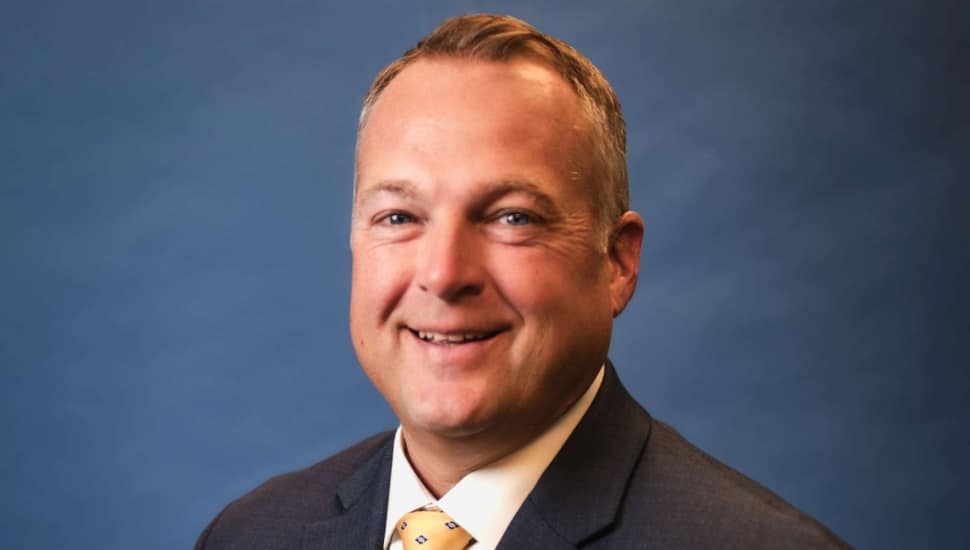

Jeffrey Steigerwalt, Regional President at Mid Penn Bank, spoke with VISTA Today about growing up in Havertown, where the Catholic community shaped his life, including childhood sports and his first job after college.
Steigerwalt began working summers in construction at age 12 and credits his father with instilling in him a strong work ethic. He also discussed how his mother-in-law helped him start his career in banking and the other mentors who propelled his career forward. Additionally, Steigerwalt shared how technological advancements have shaped his life, from college in the mid-’90s to influencing the operations of the businesses Mid Penn Bank lends to.
Where were you born and where did you grow up?
I was born the second of two boys at Fitzgerald Mercy Hospital on Lansdowne Avenue in Darby. Although my parents lived in Upper Darby at the time, I spent most of my childhood growing up in Havertown.
What did your parents do?
About a year and a half after I was born, my mother passed away.
At the time, my father had recently been honorably discharged from the military. He had studied computers in the Air Force, which was obviously groundbreaking back then, and went on to work in software with New Car Carriers and several other companies.
After my mother passed away, my father eventually remarried. My stepmother had a son, and together they had two more children, bringing the total to five.
What do you remember about growing up in Havertown?
We were very involved in the Catholic community. It wasn’t about what high school you attended but rather what parish you belonged to. Being raised on Manoa Road in Havertown, that parish for us was Sacred Heart. Everything, from sports to religious events, revolved around Sacred Heart Parish and its role within the community. Looking back, I realize it was such a small world.
You mentioned sports. Did you play sports when you were a kid?
I was part of the Hilltop Baseball League and played football, baseball, and basketball, just like everyone else in the neighborhood did. I did okay, but nothing of greatness.
I attended Episcopal Academy for high school, where I met Fitz Dixon, a former part-owner of the Eagles and other professional sports teams. He was very involved at Episcopal and in Pennsylvania’s collegiate sports world. I became relatively friendly with Mr. Dixon and had several conversations with him about various topics, including Widener University. For a variety of reasons, I chose to attend and then graduated from Widener University.
Let’s go back to high school. Did you have any part-time jobs while you were in high school?
I had a lot of jobs growing up. As one of five kids, I started working at the age of 12 to help by buying some of my own clothes and other things. At one point, my uncle said, “We need a laborer,” so I began working for Saraceni Brothers at 12 years old. For three or four summers and on the weekends, I worked as a laborer on their construction projects in Chesterfield on West Chester Pike. Mr. Saraceni would pick me up around 6:30 AM every morning and take me out to the job site, where I would lift wood and clean up debris all summer long.
In addition to that, I cut lawns and worked at the local deli called Gamble’s during high school. After my time with the Saraceni Brothers, I worked for John Byrne Painting from 15 to 18 years old.
When I went to college, I got a job with GIC Construction. There, I learned to read blueprints, managed materials in the warehouse, and then delivered those materials to the correct job location, ensuring every item was at the proper site. The company was union-based, and I assisted wherever and whenever I was needed.
What did you take from that early working experience that still shapes your life today?
Work ethic and knowing that everything you do is merit-based have always stuck with me. You might get an introduction from someone and maybe they give you an opportunity, but ultimately, you must prove that you’re capable of doing the job. I stayed at those jobs and was asked to come back every summer and even during the winter months because I showed up every day and worked hard without causing any issues.
But where does your work ethic come from?
I would say my dad has influenced my work ethic the most. He always said, “There’s five of you. When you turn 18, I don’t care what you do, but you have one of two choices: go into the military or go to college. Either way, I’m not paying for it, so good luck.” My parents were great, don’t get me wrong, but with five kids and one income, it wasn’t easy. They assisted where they could, but raising five kids is a lot to manage.
What about music? What kind of music floated your boat in high school and college?
I didn’t stick to just one genre of music. There was such an eclectic type of music coming out at that time, that was just interesting to be a part of. I still enjoyed a lot of the ’80s bands like Guns N’ Roses, Gin Blossoms, and The Cure. But by the mid-’80s to mid-’90s, rap and R&B started coming out, with artists like Run-D.M.C., MC Hammer, and Young MC.
So, you ended up at Widener University in Chester. Was Widener a good choice for you, in hindsight?
Widener is a great university, but I think any university can be good if you’re willing to put the effort into it.
I’m part of the generation that graduated in the mid-to-late ’90s. We had just gotten through the savings and loan crisis of the late 80’s and early 90’s. The internet came out when I was in college, but nobody knew how to use it. Everybody had beepers, call waiting was new, and we suddenly had all these new technological advancements happening right before our eyes. I remember the Commodore 64 and the Apple II as some of the first home computers. By the late ’90s, everybody thought online trading was the greatest thing ever, which is when I first truly understood what a bubble really meant.
For my generation, there was a lot to take in. It didn’t matter what you were studying at the time, many colleges just weren’t fully up to date and were learning things like the internet alongside the students.
So, how did you get into banking?
It’s an interesting story. I met my wife when she was 18, and we’ve been together ever since. We both grew up in the same neighborhood, but she lived on the other side of Havertown and was a couple of years behind me, so we never actually met until college when a mutual friend introduced us.
Her mother, who worked for the township, once said to me, “A bank’s coming into the township.” They had asked her, “Is there anybody you know who might have a pulse on what’s happening in Havertown that’s looking for a financial position?” She told them, “You might want to talk to my son-in-law.”
That connection led to me taking a job with Roxborough Manayunk Bank (RMB), where I started at the branches working in retail. We were later bought by Citizens Bank in the early 2000s. After the buyout, they put me in their business development and credit training programs and my career took off from there.
In addition to working at the bank, after college, I became part of the Catholic War Vets of Havertown, where my father, a war veteran, was a member. Growing up in the parish, they asked me, “Can you do us a favor and help us out with bartending a couple of these parties?” Within a couple of months, they offered me the chance to manage the hall, saying, “If you come in, run all the events, and give us our parties for practically nothing, we want you to take over the hall.”
I took them up on their offer, and as I was finishing college, I began running the Catholic War Vets, which I did for about ten years. I got to know just about everyone in the neighborhood through that role and my time there working with the war veterans. From baptisms to receptions, if you could name it, I would host it, as this venue was one of the few that could accommodate a couple of hundred guests.
Who saw promise in you, Jeff?
Citizens Bank was making a trip to acquire Roxborough Manayunk Bank. During this trip, they chose me to drive one of the executives, Mark, whose last name I can’t recall. Mark pulled me aside and said, “You’d be perfect for commercial lending. Let’s put you in the business development program.”
What do you think he saw in you?
I guess it was my personality, but I also had knowledge of the area and a solid understanding of financial capabilities.
After Citizens, between 2006 and 2007, I went on to join HSBC in their commercial lending department. Unfortunately, within a few months, the real estate crisis hit and nearly everyone at the bank left.
After that, I went back to a small community bank called Allegiance, where I met Kevin Gallagher. Kevin probably taught me the most about lending at a community bank level, where we weren’t always looking for big loans. Kevin and I got along and worked together exceptionally well. Unfortunately, that bank had an issue with a subprime company that they invested in, which eventually sunk the bank.
After the financial downfall, they sold Allegiance to Vist, which eventually became Tompkins. I took a job at a smaller bank, but was also in talks with First Niagara, just awaiting their expansion into the region. Bob Kane hired me and with Kevin’s knowledge and Bob’s support, I was able to gain visibility which allowed me to better control my part within the commercial real estate community.
Chris Terlizzi, another great mentor who I worked with exceptionally well, was also at Citizens and later at First Niagara. After First Niagara was sold to KeyBank, I stayed there for about nine months. They were very good to me, but it wasn’t exactly what I wanted to do, so I applied for a regional presidency with ESSA Bank. I stayed at ESSA Bank for approximately five years before taking an executive position at Malvern Bank. I went over to the executive position, and then we sold that within a couple of years, in August of 2023. Now here we are, opening up the South Jersey/Philadelphia market at Mid Penn Bank.
Looking back at 2024, what were your challenges? What were your opportunities?
I think the biggest challenges for a community bank, like every other bank, are not from the banks themselves but from regulations. The oversight on banks is extreme. Understandably, because of the economic downturns that have happened, we had to put constraints on various lending practices. I’m not saying we’re overregulated, but the regulations are difficult to get through. Also, the cyberattacks banks contend with daily are truly mind-blowing.
Mid Penn, with a history of approximately 160 years, is one of the strongest banks I’ve seen in terms of sustaining challenging times. We’re in a position to do really well. What our President Rory Ritrievi has accomplished since joining in 2009 is exceptional.
It’s all about having great people who are driven by the same goals. “People-centric” is the term I would use. Everybody knows your name and it’s like, “Hey, we’re all working together. Does this work?” If it doesn’t work, we all agree to move on without pointing fingers. We’re all on the same path, and that alignment is reflective of our growth and strong customer base.
Rory even developed an in-house learning center, Mid Penn University, where you can get training in a wide variety of subjects, which is unseen in most banks today.
Jeff, how do you want Mid Penn Bank to be known on the street?
We’re truly a community bank focused on servicing the needs of the folks in our communities. We’re not a large bank that will overlook the normal small business owner. We offer all the SBA programs and look for different ways to make a deal happen, rather than saying, “If you don’t fit in this box, you’re out.” I haven’t seen that approach in a long time.
Mid Penn is truly relationship-driven. If you work with us and have your accounts with Mid Penn, we will go above and beyond to make sure that you’re taken care of. One of the best things about this bank is that when you pick up the phone to call us, you get a person answering and not some recording or automated device. Customers speak with real people.
I think Mid Penn’s foundations, mixed with everything Rory Ritrievi has accomplished by investing in the technological side, are what’s driving the bank to success both now and in the future. For example, we’ve invested in cutting-edge ATMs where you press a button and a screen comes up, connecting you with a live teller who can assist with nearly anything.
Additionally, the strength of this organization is evident given our latest move. Mid Penn has just announced the merger with William Penn Bank, which will strengthen our footprint in Bucks County, allow us to expand in Philadelphia, and establish locations in both Northern and Southern New Jersey. Consumers will now see the Mid Penn brand in more places, rather than just hearing about it. This bank has the capability to compete with any bank in this region.
What do you do with your free time, Jeff?
What free time? We’re working hard to expand this region. In all seriousness, I’ve had a decent career here and again, it’s all pretty fun. I do enjoy golf!
Three last questions for you, Jeff. What’s something big that you’ve changed your mind about over the last 10 years?
Ten years ago, things were different for the local mom-and-pop companies we used to deal with. Amazon wasn’t anything like it is today and Tesla was just a blip on the radar. Now, everything is worldly. Business is still regional, but it can often feel global.
Being small-minded about the parochial Philadelphia region is no longer an option. The same company that made widgets for the local Tri-State area is now shipping overseas, or they’ve modified their technology so they can make something specific that the world needs. You have to be more mindful of what’s happening globally to know what effect it will have on the business.
Here’s a great example, someone once told me, “We’re going to do a huge deal for a taxicab company and lien their medallion.” It was a more senior person at that time telling me this. I told them I thought it was the worst idea. It was a multi-million-dollar opportunity for us to lend to back then. They asked why, and I said, “Well, there’s this thing called Uber. Have you heard of it?”
I constantly ask myself, “What don’t I know that’s already out there, which in certain realms is well-known and within six months, is going to explode?” I try to look at those technological advances since the world is changing more rapidly than ever.
It’s a crazy world out there, Jeff. What keeps you hopeful and optimistic?
It’s simple. Everybody’s going to need a bank, no matter what. Obviously, we’re talking about the industry shrinking. Technology will eliminate a lot of jobs but, at the same time, create many new and different opportunities.
Look at the strike with the dock workers. Their issue is not all about money; they have the money. Their issue is that they want to stop the technological advances they’re supposed to implement because, in three to five years, those advancements will put them out of a job. If they put the advancements in place, their jobs are going to be eliminated.
We don’t know what jobs will be available going forward, but not everybody’s going to be a tech genius. Some folks like working with their hands. What worries me is what improvements technology will bring and what detriments technology will cause. Hopefully, it’s a good balance.
Finally, Jeff, what’s the best advice you’ve ever received?
A college professor once said that whatever you do in life, make sure you have three forms of income. One will always dry up, sometimes two, but very rarely will all three. While you’re still working on one, go out and find two more.
Again, this advice was during the technological advances, when the internet just came out. So, if you can create an app, great, develop it. Or maybe both you and your spouse work, if you choose to get married, so you have two forms of income there. But find a third investment in case one of you loses your job. It could be the stock market or something else, everyone has different ideas on how to make an income for themselves.